


Vladimír Bukač, Adam Skoumal - Viola Fascination (2026)
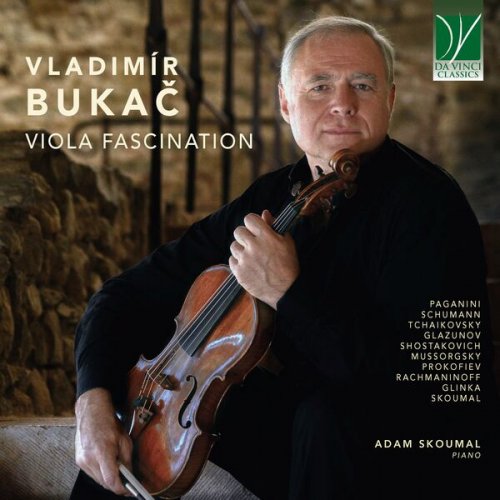
BAND/ARTIST: Vladimír Bukač, Adam Skoumal
- Title: Viola Fascination
- Year Of Release: 2026
- Label: Da Vinci Classics
- Genre: Classical
- Quality: flac lossless (tracks)
- Total Time: 00:56:59
- Total Size: 234 mb
- WebSite: Album Preview
Tracklist
01. La Campanella
02. Adagio & Allegro, Op. 70
03. Nocturne, Op. 19 No.4
04. Elegy, Op. 44
05. Spring Dance
06. Gopak from The Fair at Sorochyntsi
07. Consideration
08. Juliet as a Little Girl from Romeo and Juliet, Op. 64
09. Fantasy Pieces, Op. 3: No. 3, Melody
10. Farewell. Nocturne
11. Mercutio from Romeo and Juliet, Op. 64
12. Shalik - An Arabic Dance
The CD you hold in your hands does not aim merely to present a self‑contained programme of works, as is customary for recordings of this kind. Rather, its intention is to revive — and in some instances to bring into being — a small selection of pieces of genuine artistic value that, for various reasons, have been neglected or have never before been performed.
Some time ago a viola‑playing friend in St. Petersburg sent me a large parcel of viola scores published in Russia between the 1950s and the 1980s. Much of this repertoire comprised arrangements for the instrument by Vadim Borisovsky — whom I regard as a true master of the modern Russian school of viola playing — and by several of his virtuoso colleagues. On working through these scores, I was so taken by many of the pieces that I resolved to add them to my performing repertoire and to record them at the first opportunity. Regrettably, the playback time of this recording project has not allowed all of them to be included on the present disc.
This recording is also intended as a personal tribute to the great exponents of my instrument, such as William Primrose and Lionel Tertis, whose extraordinary artistry has enriched the viola repertoire, both through substantial original works and through smaller pieces and transcriptions. If this disc can provide inspiration to today’s younger generation of violists, including those still in training, it will have fulfilled its purpose.
I am particularly pleased to have been able to include two distinctive and highly original works for viola and piano by Adam Skoumal, who is not only a fine composer and pianist but also, above all, a valued colleague. It is my sincere hope that these pieces will find a lasting place also in the repertoire of other viola players.
In the history of the viola, virtuosity long bore the character of a conquest. For centuries the instrument inhabited the heart of the texture, the middle region of discourse, the discreet nobility of the inner register; only between the nineteenth and twentieth centuries, thanks to a lineage of performers, transcribers and composers, did it acquire a fully fledged solo prominence. The programme of this disc, significantly entitled Viola Fascination, follows a logic at once deeper and more historically revealing than that offered by the merely monographic recital. It is a project born of the desire to bring back to light pages of genuine artistic worth, often left on the margins or never truly admitted into the repertory, many of them drawn from Russian viola editions published between the 1950s and the 1980s. To this is added a homage to the great genealogy of modern viola-playing, first and foremost William Primrose and Lionel Tertis, alongside the central figure of Vadim Borisovskij. The track listing itself demonstrates this with limpid clarity, since it gathers transcriptions by Borisovskij and his colleagues beside two contemporary pages by Adam Skoumal, as though the fascination evoked by the title were to take shape at once as memory, rediscovery and renewed projection.
If Lionel Tertis was in England the great pioneer who demonstrated how the viola might honourably sustain even the upper register and the transcribed repertory, Primrose rendered that emancipation more spectacular still, going so far, in his customary vein, as to declare his wish to rescue the viola from its reputation as a subdued instrument. In Russia the decisive name was that of Vadim Borisovskij. An important study devoted to the Russian viola school observes that he essentially created the Soviet school of the viola as solo instrument, chamber instrument and pedagogical discipline, enlarging its repertory through transcriptions and new works dedicated to him. The same essay further recalls his role in the Beethoven Quartet, the ensemble that would introduce almost all of Šostakovič’s quartets, and his pedagogical activity, from which there emerged such figures as Fëdor Družinin and Jurij Bašmet. To these elements must be added a fact of decisive importance for understanding the horizon of the disc: Borisovskij contributed more than two hundred arrangements and transcriptions to the repertory of the viola and of the viola d’amore. In this light, the variety of the programme acquires a precise historical coherence. It reflects a culture of the instrument in which transcription constitutes a high form of violistic imagination.
Paganini’s La Campanella, refracted through the ingenuity of Primrose, stands at the outset as a manifesto. Nothing more clearly proclaims the will of the twentieth-century viola to appropriate violinistic vertigo and refashion it within a darker, more carnal sonic body, yet one no less agile. The tintinnabulation evoked by the title, the lightness of the leaps, the taste for caprice, all are brought back to a writing that lives by challenge and scintillation. Immediately thereafter, the Schumann of Adagio e Allegro op. 70 introduces another visage of virtuosity. The work was born for horn and piano, with alternative parts for violin and cello supplied by the composer himself, and precisely this origin explains the quality of its song, broad, breathing, sustained by a nobility of phrasing almost heraldic in instrumental bearing. In its passage to the viola, accomplished by Borisovskij, the work acquires a more intimate urgency. The Adagio speaks with gathered intensity; the Allegro preserves the impetuous gesture, yet interiorises it. To place Paganini beside Schumann is thus to establish from the outset the double status of the instrument, acrobat and confessor, theatre and monologue.
The heart of the programme, however, belongs to the Russian horizon, which Borisovskij knew how to transform into a true homeland of the viola. Čajkovskij enters it with the Notturno op. 19 no. 4, a page born within the 6 Pezzi for piano and later reworked by the composer himself for cello and small orchestra for Anatolij Brandukov. In it the melodic line seems to seek a space of confession that the viola, with its shadowed timbre, receives with an almost predestined naturalness. Glazunov appears twice: on the one hand with the Élégie op. 44, which belongs originally to the viola repertory and constitutes almost a seal of historical legitimisation within the disc; on the other with another meditative page entrusted to the arrangement of Vadim Skibin, sign that the tradition of transcribing for the viola continued in the wake of the Borisovskian lesson. To this line are joined the Melodia op. 3 no. 3 of Rachmaninov, drawn from the Morceaux de fantaisie, and the Farewell of Glinka, that is to say the nocturne La séparation, which Borisovskij felt to be so akin to his own ideal of cantabile that he returned more than once to the name of Glinka elsewhere as well, even to the point of completing his unfinished viola sonata. Here virtuosity is identified with mastery of the sustained tone, of portamento, of lyrical memory, of restrained intensity.
Alongside this elegiac vein, the disc reveals another truth of the Russian viola, its theatrical and dancing vocation. Borisovskij understood that the instrument possessed a natural aptitude for the mask, for caricature, for the sudden gesture, for the nervous energy of the stage. In this sense the Gopak of Musorgskij from the unfinished fair of Sorocińcy and the Spring Dance of Šostakovič bring into the recital the element of popular festivity, of the launched step, of rhythmic contour cut with decision. More significant still is the presence of Prokof’ev. The catalogue of the composer’s works records, among the many rewritings derived from Romeo e Giulietta, a series of versions for viola and piano due precisely to Borisovskij, including among others The Girl Juliet and Mercutio, that is to say exactly the two dramatic poles chosen here by the programme, the mobile and still almost incorporeal girlhood of Juliet and the darting, ironic, mercurial intelligence of Mercutio. Recent discography and violistic scholarship alike have continued to point to the Borisovskian version of Romeo e Giulietta as a reference point. In these transcriptions the viola ceases to be merely an inward voice and becomes a stage actor, capable of changing countenance within the space of a few bars, of passing from lyricism to sarcasm, from dance to tragic shadow.
That two pages by Adam Skoumal should be added to this path means showing that the history of violistic fascination has not run its course. In the notes devoted to his own works, Skoumal clarifies with rare precision the matrices of his imagination. Shalik, a piece of overtly virtuosic character, takes its title from an Arabic word meaning scarf and alludes to a Lebanese song heard by the composer’s wife during a journey in the Middle East; born for violin and piano, the page was later adapted for cello and for viola, and also acquired an orchestral guise. The Variations on Gypsy Melodies, by contrast, proceed from a theme encountered in the celebrated Russian film of the 1970s Gypsies Go to Heaven and openly declare the dual magnetism exercised upon Skoumal by Gypsy music and by Middle Eastern music. Here too the compositional trajectory is significant, from the duo with piano to the string and wind orchestra, all the way to the various solo versions; the score, chosen twice as the compulsory work in international violin competitions, has become the composer’s most frequently performed composition. To place these pages within an anthology dominated by transcription is to affirm that the contemporary viola may still be born of encounter, migration and metamorphosis.
The unity of the disc thus reveals itself precisely where, at first glance, it might appear to be lacking. Viola Fascination is the portrait of an instrument that has built its modernity thanks to an art of the threshold. It has assimilated the great Romantic melody, operatic recollection, ballet, the bravura piece, the salon miniature, idealised folklore, and has translated all this into a specific language marked by a mezzo-soprano tint, by a shadowed nobility, by an unceasing tension between inwardness and exteriority. The selection of pieces constitutes a small nucleus of genuine artistic value to be restored to circulation, together with a tribute to the great masters who have enriched the viola repertory both with original works and with transcriptions. Such a declaration is to be taken literally. The programme delineates part of the conquest of the viola, from transcription as an act of necessity to transcription as an act of sovereign freedom. In that passage the instrument finds its own voice, and that voice, now brilliant, now elegiac, now Gypsy-like, now theatrical, fully justifies the title of the disc.
01. La Campanella
02. Adagio & Allegro, Op. 70
03. Nocturne, Op. 19 No.4
04. Elegy, Op. 44
05. Spring Dance
06. Gopak from The Fair at Sorochyntsi
07. Consideration
08. Juliet as a Little Girl from Romeo and Juliet, Op. 64
09. Fantasy Pieces, Op. 3: No. 3, Melody
10. Farewell. Nocturne
11. Mercutio from Romeo and Juliet, Op. 64
12. Shalik - An Arabic Dance
The CD you hold in your hands does not aim merely to present a self‑contained programme of works, as is customary for recordings of this kind. Rather, its intention is to revive — and in some instances to bring into being — a small selection of pieces of genuine artistic value that, for various reasons, have been neglected or have never before been performed.
Some time ago a viola‑playing friend in St. Petersburg sent me a large parcel of viola scores published in Russia between the 1950s and the 1980s. Much of this repertoire comprised arrangements for the instrument by Vadim Borisovsky — whom I regard as a true master of the modern Russian school of viola playing — and by several of his virtuoso colleagues. On working through these scores, I was so taken by many of the pieces that I resolved to add them to my performing repertoire and to record them at the first opportunity. Regrettably, the playback time of this recording project has not allowed all of them to be included on the present disc.
This recording is also intended as a personal tribute to the great exponents of my instrument, such as William Primrose and Lionel Tertis, whose extraordinary artistry has enriched the viola repertoire, both through substantial original works and through smaller pieces and transcriptions. If this disc can provide inspiration to today’s younger generation of violists, including those still in training, it will have fulfilled its purpose.
I am particularly pleased to have been able to include two distinctive and highly original works for viola and piano by Adam Skoumal, who is not only a fine composer and pianist but also, above all, a valued colleague. It is my sincere hope that these pieces will find a lasting place also in the repertoire of other viola players.
In the history of the viola, virtuosity long bore the character of a conquest. For centuries the instrument inhabited the heart of the texture, the middle region of discourse, the discreet nobility of the inner register; only between the nineteenth and twentieth centuries, thanks to a lineage of performers, transcribers and composers, did it acquire a fully fledged solo prominence. The programme of this disc, significantly entitled Viola Fascination, follows a logic at once deeper and more historically revealing than that offered by the merely monographic recital. It is a project born of the desire to bring back to light pages of genuine artistic worth, often left on the margins or never truly admitted into the repertory, many of them drawn from Russian viola editions published between the 1950s and the 1980s. To this is added a homage to the great genealogy of modern viola-playing, first and foremost William Primrose and Lionel Tertis, alongside the central figure of Vadim Borisovskij. The track listing itself demonstrates this with limpid clarity, since it gathers transcriptions by Borisovskij and his colleagues beside two contemporary pages by Adam Skoumal, as though the fascination evoked by the title were to take shape at once as memory, rediscovery and renewed projection.
If Lionel Tertis was in England the great pioneer who demonstrated how the viola might honourably sustain even the upper register and the transcribed repertory, Primrose rendered that emancipation more spectacular still, going so far, in his customary vein, as to declare his wish to rescue the viola from its reputation as a subdued instrument. In Russia the decisive name was that of Vadim Borisovskij. An important study devoted to the Russian viola school observes that he essentially created the Soviet school of the viola as solo instrument, chamber instrument and pedagogical discipline, enlarging its repertory through transcriptions and new works dedicated to him. The same essay further recalls his role in the Beethoven Quartet, the ensemble that would introduce almost all of Šostakovič’s quartets, and his pedagogical activity, from which there emerged such figures as Fëdor Družinin and Jurij Bašmet. To these elements must be added a fact of decisive importance for understanding the horizon of the disc: Borisovskij contributed more than two hundred arrangements and transcriptions to the repertory of the viola and of the viola d’amore. In this light, the variety of the programme acquires a precise historical coherence. It reflects a culture of the instrument in which transcription constitutes a high form of violistic imagination.
Paganini’s La Campanella, refracted through the ingenuity of Primrose, stands at the outset as a manifesto. Nothing more clearly proclaims the will of the twentieth-century viola to appropriate violinistic vertigo and refashion it within a darker, more carnal sonic body, yet one no less agile. The tintinnabulation evoked by the title, the lightness of the leaps, the taste for caprice, all are brought back to a writing that lives by challenge and scintillation. Immediately thereafter, the Schumann of Adagio e Allegro op. 70 introduces another visage of virtuosity. The work was born for horn and piano, with alternative parts for violin and cello supplied by the composer himself, and precisely this origin explains the quality of its song, broad, breathing, sustained by a nobility of phrasing almost heraldic in instrumental bearing. In its passage to the viola, accomplished by Borisovskij, the work acquires a more intimate urgency. The Adagio speaks with gathered intensity; the Allegro preserves the impetuous gesture, yet interiorises it. To place Paganini beside Schumann is thus to establish from the outset the double status of the instrument, acrobat and confessor, theatre and monologue.
The heart of the programme, however, belongs to the Russian horizon, which Borisovskij knew how to transform into a true homeland of the viola. Čajkovskij enters it with the Notturno op. 19 no. 4, a page born within the 6 Pezzi for piano and later reworked by the composer himself for cello and small orchestra for Anatolij Brandukov. In it the melodic line seems to seek a space of confession that the viola, with its shadowed timbre, receives with an almost predestined naturalness. Glazunov appears twice: on the one hand with the Élégie op. 44, which belongs originally to the viola repertory and constitutes almost a seal of historical legitimisation within the disc; on the other with another meditative page entrusted to the arrangement of Vadim Skibin, sign that the tradition of transcribing for the viola continued in the wake of the Borisovskian lesson. To this line are joined the Melodia op. 3 no. 3 of Rachmaninov, drawn from the Morceaux de fantaisie, and the Farewell of Glinka, that is to say the nocturne La séparation, which Borisovskij felt to be so akin to his own ideal of cantabile that he returned more than once to the name of Glinka elsewhere as well, even to the point of completing his unfinished viola sonata. Here virtuosity is identified with mastery of the sustained tone, of portamento, of lyrical memory, of restrained intensity.
Alongside this elegiac vein, the disc reveals another truth of the Russian viola, its theatrical and dancing vocation. Borisovskij understood that the instrument possessed a natural aptitude for the mask, for caricature, for the sudden gesture, for the nervous energy of the stage. In this sense the Gopak of Musorgskij from the unfinished fair of Sorocińcy and the Spring Dance of Šostakovič bring into the recital the element of popular festivity, of the launched step, of rhythmic contour cut with decision. More significant still is the presence of Prokof’ev. The catalogue of the composer’s works records, among the many rewritings derived from Romeo e Giulietta, a series of versions for viola and piano due precisely to Borisovskij, including among others The Girl Juliet and Mercutio, that is to say exactly the two dramatic poles chosen here by the programme, the mobile and still almost incorporeal girlhood of Juliet and the darting, ironic, mercurial intelligence of Mercutio. Recent discography and violistic scholarship alike have continued to point to the Borisovskian version of Romeo e Giulietta as a reference point. In these transcriptions the viola ceases to be merely an inward voice and becomes a stage actor, capable of changing countenance within the space of a few bars, of passing from lyricism to sarcasm, from dance to tragic shadow.
That two pages by Adam Skoumal should be added to this path means showing that the history of violistic fascination has not run its course. In the notes devoted to his own works, Skoumal clarifies with rare precision the matrices of his imagination. Shalik, a piece of overtly virtuosic character, takes its title from an Arabic word meaning scarf and alludes to a Lebanese song heard by the composer’s wife during a journey in the Middle East; born for violin and piano, the page was later adapted for cello and for viola, and also acquired an orchestral guise. The Variations on Gypsy Melodies, by contrast, proceed from a theme encountered in the celebrated Russian film of the 1970s Gypsies Go to Heaven and openly declare the dual magnetism exercised upon Skoumal by Gypsy music and by Middle Eastern music. Here too the compositional trajectory is significant, from the duo with piano to the string and wind orchestra, all the way to the various solo versions; the score, chosen twice as the compulsory work in international violin competitions, has become the composer’s most frequently performed composition. To place these pages within an anthology dominated by transcription is to affirm that the contemporary viola may still be born of encounter, migration and metamorphosis.
The unity of the disc thus reveals itself precisely where, at first glance, it might appear to be lacking. Viola Fascination is the portrait of an instrument that has built its modernity thanks to an art of the threshold. It has assimilated the great Romantic melody, operatic recollection, ballet, the bravura piece, the salon miniature, idealised folklore, and has translated all this into a specific language marked by a mezzo-soprano tint, by a shadowed nobility, by an unceasing tension between inwardness and exteriority. The selection of pieces constitutes a small nucleus of genuine artistic value to be restored to circulation, together with a tribute to the great masters who have enriched the viola repertory both with original works and with transcriptions. Such a declaration is to be taken literally. The programme delineates part of the conquest of the viola, from transcription as an act of necessity to transcription as an act of sovereign freedom. In that passage the instrument finds its own voice, and that voice, now brilliant, now elegiac, now Gypsy-like, now theatrical, fully justifies the title of the disc.
| Classical | FLAC / APE
As a ISRA.CLOUD's PREMIUM member you will have the following benefits:
- Unlimited high speed downloads
- Download directly without waiting time
- Unlimited parallel downloads
- Support for download accelerators
- No advertising
- Resume broken downloads