


Francesco Padovani, Roberto Loreggian, Francesco Galligioni - Johann Sebastian Bach: Flute Sonatas with Basso Continuo (2026)
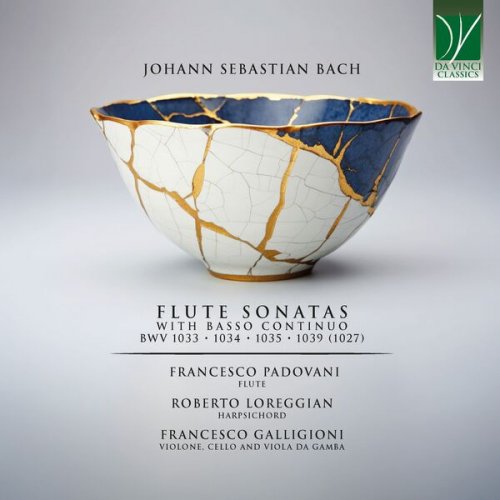
BAND/ARTIST: Francesco Padovani, Roberto Loreggian, Francesco Galligioni
- Title: Johann Sebastian Bach: Flute Sonatas with Basso Continuo
- Year Of Release: 2026
- Label: Da Vinci Classics
- Genre: Classical
- Quality: flac lossless (tracks)
- Total Time: 00:49:02
- Total Size: 272 mb
- WebSite: Album Preview
Tracklist
01. Flute Sonata in C Major, BWV 1033: I. Andante – Presto
02. Flute Sonata in C Major, BWV 1033: II. Allegro
03. Flute Sonata in C Major, BWV 1033: III. Adagio
04. Flute Sonata in D Major, BWV 1033: IV. Menuet I and II
05. Flute Sonata in E Minor, BWV 1034: I. Adagio ma non tanto
06. Flute Sonata in E Minor, BWV 1034: II. Allegro
07. Flute Sonata in E Minor, BWV 1034: III. Andante
08. Flute Sonata in E Minor, BWV 1034: IV. Allegro
09. Flute Sonata in E Major, BWV 1035: I. Adagio ma non tanto
10. Flute Sonata in E Major, BWV 1035: II. Allegro
11. Flute Sonata in E Major, BWV 1035: III. Siciliana
12. Flute Sonata in E Major, BWV 1035: IV. Allegro assai
13. Flute Sonata in G Major, BWV 1039: I. Adagio
14. Flute Sonata in G Major, BWV 1039: II. Allegro ma non presto
15. Flute Sonata in G Major, BWV 1039: III. Adagio e piano
16. Flute Sonata in G Major, BWV 1039: IV. Allegro moderato
Among the many constellations of Bachian chamber music, the one that gathers around the traverso possesses a particular fascination. The instrument, relatively new to Bach and becoming decisive above all in the Leipzig years, introduces into his writing a quality of breath, of timbral suppleness and of linear eloquence that coincides neither with the severity of the organ nor with the brilliance of the violin. The programme of this disc, bringing together Sonata in C major BWV 1033, Sonata in E minor BWV 1034, Sonata in E major BWV 1035 and Sonata in G major BWV 1039, explicitly placed in relation to BWV 1027, does not offer a mere anthology of pages for flute. It proposes instead an itinerary into the Bachian workshop, where the relation between melody and basso continuo, between form and version, between attribution and transmission, becomes part of musical meaning itself. In these works the bass does not serve merely as accompaniment, but argues, contradicts, sustains and at times even leads. The flute, for its part, does not confine itself to singing. It thinks in sound, with a naturalness that in Bach always possesses something architectural.
The collection also possesses an inner coherence that is less immediately apparent, yet decisive. At the extremities stand C major and G major, open keys, almost perspectival in character; at the centre lies the dyad of E minor and E major, as though the programme wished to trace a trajectory from initial penumbra to utmost clarity, only then to reopen the discourse within the spaciousness of the trio sonata. On the level of the sources, too, the itinerary is eloquent. None of these pages presents itself as a simply given textual object. BWV 1033 lives beneath the sign of uncertain attribution, BWV 1034 and BWV 1035 are entrusted to copies and to non-autograph traditions, and BWV 1039 can be fully understood only in relation to its constellation of versions. Philology, in this instance, is an essential component, for it reveals a Bach whose chamber music can pass from one hand to another, from one instrument to another, from one function to another, without forfeiting its identity.
Sonata in C major BWV 1033 immediately introduces the question of the threshold. Tradition transmits it in a manuscript by the young Carl Philipp Emanuel Bach, who attributes it to his father, and the subsequent eighteenth-century confirmation has prevented the work from slipping altogether outside the Bachian catalogue. Yet the simplicity of the bass, the composite nature of certain materials, and the impression that at least part of the flute writing may originally have had another destination have nourished a discussion that has never wholly subsided. Rather than an obstacle, this uncertainty illumines the domestic and workshop-like climate in which the page appears to have come into being. The Andante – Presto and the Allegro possess the fluency of an almost improvised discourse, the Adagio opens an expressive centre of absorbed melancholy, while the two Menuets restore the music to a measure of elegant sociability. One senses here a Bach of the borderland, or perhaps a Bach filtered through the filial hand, yet the quality of the melodic profile remains unmistakable. The sonata lives, indeed, by virtue of its very ambiguity, like a finely chiselled miniature whose fascination is born also of the penumbra surrounding it.
With Sonata in E minor BWV 1034 the picture grows clearer. The earliest sources place it in the initial Leipzig years, and its formal profile, slow-fast-slow-fast, clearly binds it to the tradition of the church sonata. Yet in Bach formal genealogy is always living matter. Already in the Adagio ma non tanto the flute line, traversed by sighs and by slight dolorous delays, confronts a bass of astonishing autonomy. The ensuing Allegro, constructed upon an arpeggiated energy recalling the Italian violinistic inheritance, renders it yet more evident that here the continuo is not a mere backdrop but a true interlocutor. The Andante entrusts to the flute a long, almost improvised song, stretched above a regular motion in the bass, while the finale resumes that impulse in a form tauter and more impassioned. More than a sonata for flute with accompaniment, BWV 1034 thus appears as a duet of high conversation, in which the traverso and the continuo divide between them the burden of thought. It is one of the points at which Bach shows most clearly that he had understood the new instrument as the principle of a new kind of writing.
The relation between BWV 1034 and BWV 1035 also deserves to be heard as a diptych. The two sonatas share the same tonal fundamental, yet they belong to different stylistic worlds. The first still looks, with full awareness, towards the order of the church sonata and the Italian lesson; the second absorbs the new Berlin sensibility, the fragmentation of affective gesture, the taste for a more mobile and psychological cantabile. Between the two there runs almost an entire history of the German eighteenth century, condensed into the voice of the traverso. The very same instrument that in BWV 1034 argues with austere composure becomes in BWV 1035 more insinuating, more changeful, closer to an inward utterance. It is one of the great merits of the programme to lay bare such a transformation without forcing it, allowing the quality of the writing itself to narrate the passage from the Bach of full maturity to the Bach of the final years.
Sonata in E major BWV 1035 belongs, indeed, to the late Bach, by then close to the Berlin world and potentially in contact with the milieu of Frederick II. The sources connect it with good probability to the visit undertaken in 1741 and to the figure of Michael Gabriel Fredersdorf, the King’s valet de chambre, an amateur flautist of cultivation and one well integrated into the taste of the Prussian court. Such a context illuminates the physiognomy of the piece. Here Bach opens himself with singular naturalness to the inflections of galant language and of Empfindsamkeit, without in any way renouncing his own constructive authority. The first movement and the Siciliana seem to belong to a sphere of sensibility more vulnerable, more nuanced, almost close to the new North German aesthetic; the second and fourth movements retain instead a rhythmic clarity and brilliance more directly bound to the late Baroque manner. Some scholars have even read the entire sonata as a sort of miniature suite, with prelude and internalised dances. In any case, the result is one of the most subtle regions of late Bachian chamber music. The key of E major, rendered particularly eloquent also by the technical resources of the Quantzian flute in use at court, causes the page to resound in a limpid, noble and delicately sensitive light.
The conclusion with Sonata in G major BWV 1039, significantly presented in the track listing in relation to BWV 1027 and entrusted to flute, viola da gamba and basso continuo, leads the discourse into one of the most fascinating zones of mobility within the Bach catalogue. Scholarship agrees in holding that the version for two flutes and continuo and that for viola da gamba and obbligato harpsichord both refer back to a lost earlier stage, perhaps a trio sonata for another instrumental combination. What matters, even more than chronological priority, is the extraordinary readiness of this music to pass from one sounding body to another. The page breathes like a true trio sonata, constructed upon the equilibrium of the upper voices and upon the fertility of the bass, yet it already contains that cantabile tension that would make its migration towards the viola da gamba seem entirely natural. In the opening Adagio, in the Allegro ma non presto, in the collected Adagio e piano and in the final movement, here brought close to the lesson of BWV 1027, Bach shows how chamber writing may preserve its identity even while changing incarnation.
Heard in this succession, the four sonatas delineate a portrait of Bach for flute that is less obvious and perhaps more revealing than would emerge from a purely canonical anthology. BWV 1033 opens with its problematic and domestic aura, almost like a half-open door onto the domestic workshop of the Bach family. BWV 1034 confers upon the traverso a full dialectical dignity, making of the continuo a partner of equal weight. BWV 1035 brings into the writing the late luminosity, the contact with Berlin, the permeability to new styles. BWV 1039, finally, extends the discourse from the sonata to the principle of version, of transmigration, of form surviving by changing its skin. For this reason too the programme possesses a strong hidden unity. From the almost subdued bass of BWV 1033 to the argumentative fertility of BWV 1039, the whole disc may be heard as a meditation upon the responsibility of the continuo, which in Bach coincides with the memory of harmony itself. The overall result is a book on musical conversation. Here every voice listens and is listened to, every line bears within itself harmonic memory, every movement is born of a measure that never oppresses song. In this art of supervised breath, of density without weight, of clarity nourished by shadow, the traverso finds one of its earliest and highest European consecrations. Bach speaks here with an accent less monumental than that of the great sacred or keyboard architectures, yet no less profound. He speaks as one who knows that intimacy, in chamber music, may preserve a form of perfectly sovereign greatness.
01. Flute Sonata in C Major, BWV 1033: I. Andante – Presto
02. Flute Sonata in C Major, BWV 1033: II. Allegro
03. Flute Sonata in C Major, BWV 1033: III. Adagio
04. Flute Sonata in D Major, BWV 1033: IV. Menuet I and II
05. Flute Sonata in E Minor, BWV 1034: I. Adagio ma non tanto
06. Flute Sonata in E Minor, BWV 1034: II. Allegro
07. Flute Sonata in E Minor, BWV 1034: III. Andante
08. Flute Sonata in E Minor, BWV 1034: IV. Allegro
09. Flute Sonata in E Major, BWV 1035: I. Adagio ma non tanto
10. Flute Sonata in E Major, BWV 1035: II. Allegro
11. Flute Sonata in E Major, BWV 1035: III. Siciliana
12. Flute Sonata in E Major, BWV 1035: IV. Allegro assai
13. Flute Sonata in G Major, BWV 1039: I. Adagio
14. Flute Sonata in G Major, BWV 1039: II. Allegro ma non presto
15. Flute Sonata in G Major, BWV 1039: III. Adagio e piano
16. Flute Sonata in G Major, BWV 1039: IV. Allegro moderato
Among the many constellations of Bachian chamber music, the one that gathers around the traverso possesses a particular fascination. The instrument, relatively new to Bach and becoming decisive above all in the Leipzig years, introduces into his writing a quality of breath, of timbral suppleness and of linear eloquence that coincides neither with the severity of the organ nor with the brilliance of the violin. The programme of this disc, bringing together Sonata in C major BWV 1033, Sonata in E minor BWV 1034, Sonata in E major BWV 1035 and Sonata in G major BWV 1039, explicitly placed in relation to BWV 1027, does not offer a mere anthology of pages for flute. It proposes instead an itinerary into the Bachian workshop, where the relation between melody and basso continuo, between form and version, between attribution and transmission, becomes part of musical meaning itself. In these works the bass does not serve merely as accompaniment, but argues, contradicts, sustains and at times even leads. The flute, for its part, does not confine itself to singing. It thinks in sound, with a naturalness that in Bach always possesses something architectural.
The collection also possesses an inner coherence that is less immediately apparent, yet decisive. At the extremities stand C major and G major, open keys, almost perspectival in character; at the centre lies the dyad of E minor and E major, as though the programme wished to trace a trajectory from initial penumbra to utmost clarity, only then to reopen the discourse within the spaciousness of the trio sonata. On the level of the sources, too, the itinerary is eloquent. None of these pages presents itself as a simply given textual object. BWV 1033 lives beneath the sign of uncertain attribution, BWV 1034 and BWV 1035 are entrusted to copies and to non-autograph traditions, and BWV 1039 can be fully understood only in relation to its constellation of versions. Philology, in this instance, is an essential component, for it reveals a Bach whose chamber music can pass from one hand to another, from one instrument to another, from one function to another, without forfeiting its identity.
Sonata in C major BWV 1033 immediately introduces the question of the threshold. Tradition transmits it in a manuscript by the young Carl Philipp Emanuel Bach, who attributes it to his father, and the subsequent eighteenth-century confirmation has prevented the work from slipping altogether outside the Bachian catalogue. Yet the simplicity of the bass, the composite nature of certain materials, and the impression that at least part of the flute writing may originally have had another destination have nourished a discussion that has never wholly subsided. Rather than an obstacle, this uncertainty illumines the domestic and workshop-like climate in which the page appears to have come into being. The Andante – Presto and the Allegro possess the fluency of an almost improvised discourse, the Adagio opens an expressive centre of absorbed melancholy, while the two Menuets restore the music to a measure of elegant sociability. One senses here a Bach of the borderland, or perhaps a Bach filtered through the filial hand, yet the quality of the melodic profile remains unmistakable. The sonata lives, indeed, by virtue of its very ambiguity, like a finely chiselled miniature whose fascination is born also of the penumbra surrounding it.
With Sonata in E minor BWV 1034 the picture grows clearer. The earliest sources place it in the initial Leipzig years, and its formal profile, slow-fast-slow-fast, clearly binds it to the tradition of the church sonata. Yet in Bach formal genealogy is always living matter. Already in the Adagio ma non tanto the flute line, traversed by sighs and by slight dolorous delays, confronts a bass of astonishing autonomy. The ensuing Allegro, constructed upon an arpeggiated energy recalling the Italian violinistic inheritance, renders it yet more evident that here the continuo is not a mere backdrop but a true interlocutor. The Andante entrusts to the flute a long, almost improvised song, stretched above a regular motion in the bass, while the finale resumes that impulse in a form tauter and more impassioned. More than a sonata for flute with accompaniment, BWV 1034 thus appears as a duet of high conversation, in which the traverso and the continuo divide between them the burden of thought. It is one of the points at which Bach shows most clearly that he had understood the new instrument as the principle of a new kind of writing.
The relation between BWV 1034 and BWV 1035 also deserves to be heard as a diptych. The two sonatas share the same tonal fundamental, yet they belong to different stylistic worlds. The first still looks, with full awareness, towards the order of the church sonata and the Italian lesson; the second absorbs the new Berlin sensibility, the fragmentation of affective gesture, the taste for a more mobile and psychological cantabile. Between the two there runs almost an entire history of the German eighteenth century, condensed into the voice of the traverso. The very same instrument that in BWV 1034 argues with austere composure becomes in BWV 1035 more insinuating, more changeful, closer to an inward utterance. It is one of the great merits of the programme to lay bare such a transformation without forcing it, allowing the quality of the writing itself to narrate the passage from the Bach of full maturity to the Bach of the final years.
Sonata in E major BWV 1035 belongs, indeed, to the late Bach, by then close to the Berlin world and potentially in contact with the milieu of Frederick II. The sources connect it with good probability to the visit undertaken in 1741 and to the figure of Michael Gabriel Fredersdorf, the King’s valet de chambre, an amateur flautist of cultivation and one well integrated into the taste of the Prussian court. Such a context illuminates the physiognomy of the piece. Here Bach opens himself with singular naturalness to the inflections of galant language and of Empfindsamkeit, without in any way renouncing his own constructive authority. The first movement and the Siciliana seem to belong to a sphere of sensibility more vulnerable, more nuanced, almost close to the new North German aesthetic; the second and fourth movements retain instead a rhythmic clarity and brilliance more directly bound to the late Baroque manner. Some scholars have even read the entire sonata as a sort of miniature suite, with prelude and internalised dances. In any case, the result is one of the most subtle regions of late Bachian chamber music. The key of E major, rendered particularly eloquent also by the technical resources of the Quantzian flute in use at court, causes the page to resound in a limpid, noble and delicately sensitive light.
The conclusion with Sonata in G major BWV 1039, significantly presented in the track listing in relation to BWV 1027 and entrusted to flute, viola da gamba and basso continuo, leads the discourse into one of the most fascinating zones of mobility within the Bach catalogue. Scholarship agrees in holding that the version for two flutes and continuo and that for viola da gamba and obbligato harpsichord both refer back to a lost earlier stage, perhaps a trio sonata for another instrumental combination. What matters, even more than chronological priority, is the extraordinary readiness of this music to pass from one sounding body to another. The page breathes like a true trio sonata, constructed upon the equilibrium of the upper voices and upon the fertility of the bass, yet it already contains that cantabile tension that would make its migration towards the viola da gamba seem entirely natural. In the opening Adagio, in the Allegro ma non presto, in the collected Adagio e piano and in the final movement, here brought close to the lesson of BWV 1027, Bach shows how chamber writing may preserve its identity even while changing incarnation.
Heard in this succession, the four sonatas delineate a portrait of Bach for flute that is less obvious and perhaps more revealing than would emerge from a purely canonical anthology. BWV 1033 opens with its problematic and domestic aura, almost like a half-open door onto the domestic workshop of the Bach family. BWV 1034 confers upon the traverso a full dialectical dignity, making of the continuo a partner of equal weight. BWV 1035 brings into the writing the late luminosity, the contact with Berlin, the permeability to new styles. BWV 1039, finally, extends the discourse from the sonata to the principle of version, of transmigration, of form surviving by changing its skin. For this reason too the programme possesses a strong hidden unity. From the almost subdued bass of BWV 1033 to the argumentative fertility of BWV 1039, the whole disc may be heard as a meditation upon the responsibility of the continuo, which in Bach coincides with the memory of harmony itself. The overall result is a book on musical conversation. Here every voice listens and is listened to, every line bears within itself harmonic memory, every movement is born of a measure that never oppresses song. In this art of supervised breath, of density without weight, of clarity nourished by shadow, the traverso finds one of its earliest and highest European consecrations. Bach speaks here with an accent less monumental than that of the great sacred or keyboard architectures, yet no less profound. He speaks as one who knows that intimacy, in chamber music, may preserve a form of perfectly sovereign greatness.
| Classical | FLAC / APE
As a ISRA.CLOUD's PREMIUM member you will have the following benefits:
- Unlimited high speed downloads
- Download directly without waiting time
- Unlimited parallel downloads
- Support for download accelerators
- No advertising
- Resume broken downloads