


Daniele Berdini, Luca Romagnoli - Nuances - Saxophone Music from Salon to City (2026)
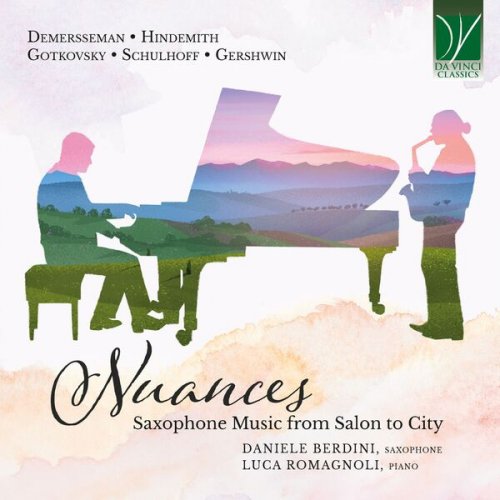
BAND/ARTIST: Daniele Berdini, Luca Romagnoli
- Title: Nuances - Saxophone Music from Salon to City
- Year Of Release: 2026
- Label: Da Vinci Classics
- Genre: Classical
- Quality: flac lossless (tracks)
- Total Time: 00:50:36
- Total Size: 212 mb
- WebSite: Album Preview
Tracklist
01. Fantaisie sur un thème original
02. Sonate: No. 1, Ruhig bewegt
03. Sonate: No. 2, Lebhaft
04. Sonate: No. 3, Sehr langsam
05. Sonate: No. 4, Lebhaft
06. Brillance: No. 1, Déclamé
07. Brillance: No. 2, Désinvolte
08. Brillance: No. 3, Dolcissimo
09. Brillance: No. 4, Final
10. Hot Sonate: No. 1
11. Hot Sonate: No. 2
12. Hot Sonate: No. 3
13. Hot Sonate: No. 4
14. Three Preludes: No. 1, Allegro ben ritmato e deciso
15. Three Preludes: No. 2, Andante con moto
16. Three Preludes: No. 3, Agitato
The saxophone already bears within its very name a destiny of voice. Adolphe Sax conceived it as an instrument of mediation between distinct timbral families, and its history soon unfolded along two complementary lines, the nobility of song and the seduction of rhythm. The programme of this disc, bringing together Jules Demersseman, Paul Hindemith, Ida Gotkovsky, Erwin Schulhoff and George Gershwin, follows that dual vocation with rare clarity. From the Paris that witnessed the birth of the first cornerstones of the repertory to the restless Mitteleuropa of the twentieth century, and onward to the America in which jazz and cultivated composition touch, the alto saxophone appears here as an instrument of the frontier, capable of embracing the cantabile of the romance, the rigour of the sonata, the spark of dance and the energy of the modern city. The track listing itself suggests a coherent dramaturgy, in which works conceived for the saxophone coexist with pages that the saxophone has ultimately come to claim as its own.
With Jules Demersseman this story begins almost at its source. A virtuoso flautist and among the earliest composers to grasp the novelty of Sax’s new instrument, Demersseman entrusted to the saxophone a page belonging to its noble origins. The Fantaisie sur un thème original, dedicated to Henri Wuille, the Belgian clarinettist who also trained on the saxophone with its inventor and soon became one of the earliest soloists in northern Europe, is indeed among the first significant contributions to the repertory. Its structure, a theme and variations preceded by a pianistic introduction of marked theatrical prominence, makes it possible to display with limpid clarity the qualities the new instrument offered to Romantic sensibility, suppleness of phrasing, agility, breadth of register, and the possibility of an almost improvised cadenza. The saxophone here still appears youthful, yet already endowed with a fully formed scenic identity. The melancholy of the opening theme, the progressive thickening of ornament, and the ascent towards a brilliant conclusion narrate the entry of the saxophone into the French concert salon with an assurance already remarkable.
With Hindemith the discourse changes profoundly in stature and in function. The Sonata belongs to the great cycle of sonatas for wind instruments and piano conceived during the years of American exile, and bears with it the full constructive lucidity of a style that restores to each instrument its own moral profile. The work was originally destined for the E flat Althorn, or mellophone, yet the Schott edition itself authorises performance on the alto saxophone, a sign of the timbral proximity and shared vocal region that the repertory has by now sanctioned. The first movement sets forth a pensive calm, almost pastoral, at once traversed by an irregular counterpoint; the second possesses a tighter nervousness; the Sehr langsam concentrates song into a brief and inward zone. Before the finale there stands, in the original conception, Das Posthorn, a poetic dialogue in which Hindemith reflects upon the sound of the horn as a memory of distance and as an ethical task of listening. The concluding Lebhaft resumes that tension and transforms it into energetic motion, within an equilibrium uniting abstraction and warmth. On the saxophone this sonata preserves intact its austere nobility and acquires a more human, almost vocal colouring.
If Hindemith assigns to the saxophone a higher discipline, Ida Gotkovsky explores its timbral magnificence from within the great French tradition of the later twentieth century. Trained at the Conservatoire in Paris with Olivier Messiaen and Nadia Boulanger, Gotkovsky built a substantial part of her output around wind instruments, and the saxophone occupies within that universe a privileged place. Brillance bears its poetic programme in its very title. It is a work in four movements, entirely founded upon the idea of a mobile, free eloquence, capable of passing from invocation to dancing lightness, from gathered cantabile to final impetus. The Déclamé proceeds like a broad improvisatory arch, marked by dynamic extremes and by a writing that seems to come into being at the very moment of utterance. Desinvolte assumes the character of a scherzo with an almost choreographic humour; Dolcissimo returns the discourse to a restrained tenderness of clearly lyrical ancestry; the Final gathers and relaunches, in a more sharply defined form, the perpetuum mobile and the articulatory energy that course through the whole composition. In this score the saxophone becomes the place in which the French school of clarity, colour and rhythmic flexibility encounters a virtuosity conceived as a form of thought.
Erwin Schulhoff, by contrast, places the saxophone in the fevered heart of urban modernity. One of the most singular figures of the Central European avant-garde, capable of traversing Dada, neoclassicism, dance music and an early relationship with jazz, Schulhoff found in the saxophone a perfect instrument for a writing of oblique, ironic and sensual profile. The Hot-Sonate, commissioned by the Berlin radio station Funk-Stunde and premiered with Billy Barton and the composer at the piano, assumes from its title onward the American vocabulary of jazz. At that time the word hot designated a way of playing and inhabiting rhythm, heated, nervous, vibrant. The four movements, indicated only by metronome marks and a few character indications, compose a sequence of strong theatrical evidence. The first advances through spiced harmonies and supple syncopations; the second is rapid and almost darting; the third introduces a climate of distorted blues, dolorous and grotesque; the finale resolves the tension into a vitality retaining something of cabaret and something of the modern machine. The piece occupies a decisive place in the history of the repertory, because it shows with complete naturalness that the saxophone could enter the sphere of art music without renouncing its own sonic modernity.
In George Gershwin that modernity attains a form of crystalline synthesis. The Three Preludes were conceived for piano and remain the only true concert pieces for solo piano published during the composer’s lifetime. Their presence in a programme for saxophone and piano nonetheless possesses an almost instinctive necessity. Few composers have written music more naturally inclined towards breath, the inflection of the blue note, and the mingling of cultivated gesture with popular idioms. Gershwin had imagined a far larger cycle, almost a modern book of American preludes, and the three survivors offer a perfect concentrate of his poetics. The first, Allegro ben ritmato e deciso, lives by biting syncopations and an opening theme strongly marked by the blues; the second, Andante con moto, unfolds like a blues lullaby, inward and nocturnal; the third, Agitato, bears within it that Hispano-American component running through so much urban music between Broadway, Harlem and Latin rhythms. On the alto saxophone such preludes seem to return to an implicit vocal matrix, as though the Gershwinian piano were at last releasing a song already present within the page.
One further element unites all these works with particular clarity, the role of the piano. In Demersseman it raises the curtain and organises the scene of variation. In Hindemith it dialogues with the soloist on equal terms, according to that taut chamber conception constituting one of the highest signs of his style. In Gotkovsky it becomes percussive surface, changing harmony, support and contrast, almost a second mirror of the saxophone. In Schulhoff it turns into rhythmic motor and theatrical machine, the seat of syncopations and harmonies leaning towards jazz. In Gershwin, finally, the piano remains the original matrix of invention, the place in which the lexicon of the blues and of urban dance first found fixation in a brief and memorable form. The disc thus also offers a history of the relationship between keyboard and saxophone, a relationship traversing the Romantic salon, the twentieth-century sonata, cultivated cabaret and metropolitan America.
Heard in its entirety, this programme thus delineates a true genealogy of the saxophone. Demersseman shows its act of birth within a still nineteenth-century and theatrical horizon. Hindemith places it within the domain of severe form and reflection. Gotkovsky restores it to the great French tradition of timbre and eloquence. Schulhoff makes it the restless protagonist of the electric city. Gershwin illumines its American destiny, suspended between blues, dance and secular prayer. What emerges is the portrait of an instrument that brought into the twentieth century a rare quality, the capacity to appear at once aristocratic and popular, disciplined and sensual, solitary and theatrical. In that duality perhaps resides its deepest truth. Every page on the disc confirms it with different inflections and with a coherence that surpasses national frontiers. Here the saxophone becomes the very voice of a modernity that has learned to sing.
01. Fantaisie sur un thème original
02. Sonate: No. 1, Ruhig bewegt
03. Sonate: No. 2, Lebhaft
04. Sonate: No. 3, Sehr langsam
05. Sonate: No. 4, Lebhaft
06. Brillance: No. 1, Déclamé
07. Brillance: No. 2, Désinvolte
08. Brillance: No. 3, Dolcissimo
09. Brillance: No. 4, Final
10. Hot Sonate: No. 1
11. Hot Sonate: No. 2
12. Hot Sonate: No. 3
13. Hot Sonate: No. 4
14. Three Preludes: No. 1, Allegro ben ritmato e deciso
15. Three Preludes: No. 2, Andante con moto
16. Three Preludes: No. 3, Agitato
The saxophone already bears within its very name a destiny of voice. Adolphe Sax conceived it as an instrument of mediation between distinct timbral families, and its history soon unfolded along two complementary lines, the nobility of song and the seduction of rhythm. The programme of this disc, bringing together Jules Demersseman, Paul Hindemith, Ida Gotkovsky, Erwin Schulhoff and George Gershwin, follows that dual vocation with rare clarity. From the Paris that witnessed the birth of the first cornerstones of the repertory to the restless Mitteleuropa of the twentieth century, and onward to the America in which jazz and cultivated composition touch, the alto saxophone appears here as an instrument of the frontier, capable of embracing the cantabile of the romance, the rigour of the sonata, the spark of dance and the energy of the modern city. The track listing itself suggests a coherent dramaturgy, in which works conceived for the saxophone coexist with pages that the saxophone has ultimately come to claim as its own.
With Jules Demersseman this story begins almost at its source. A virtuoso flautist and among the earliest composers to grasp the novelty of Sax’s new instrument, Demersseman entrusted to the saxophone a page belonging to its noble origins. The Fantaisie sur un thème original, dedicated to Henri Wuille, the Belgian clarinettist who also trained on the saxophone with its inventor and soon became one of the earliest soloists in northern Europe, is indeed among the first significant contributions to the repertory. Its structure, a theme and variations preceded by a pianistic introduction of marked theatrical prominence, makes it possible to display with limpid clarity the qualities the new instrument offered to Romantic sensibility, suppleness of phrasing, agility, breadth of register, and the possibility of an almost improvised cadenza. The saxophone here still appears youthful, yet already endowed with a fully formed scenic identity. The melancholy of the opening theme, the progressive thickening of ornament, and the ascent towards a brilliant conclusion narrate the entry of the saxophone into the French concert salon with an assurance already remarkable.
With Hindemith the discourse changes profoundly in stature and in function. The Sonata belongs to the great cycle of sonatas for wind instruments and piano conceived during the years of American exile, and bears with it the full constructive lucidity of a style that restores to each instrument its own moral profile. The work was originally destined for the E flat Althorn, or mellophone, yet the Schott edition itself authorises performance on the alto saxophone, a sign of the timbral proximity and shared vocal region that the repertory has by now sanctioned. The first movement sets forth a pensive calm, almost pastoral, at once traversed by an irregular counterpoint; the second possesses a tighter nervousness; the Sehr langsam concentrates song into a brief and inward zone. Before the finale there stands, in the original conception, Das Posthorn, a poetic dialogue in which Hindemith reflects upon the sound of the horn as a memory of distance and as an ethical task of listening. The concluding Lebhaft resumes that tension and transforms it into energetic motion, within an equilibrium uniting abstraction and warmth. On the saxophone this sonata preserves intact its austere nobility and acquires a more human, almost vocal colouring.
If Hindemith assigns to the saxophone a higher discipline, Ida Gotkovsky explores its timbral magnificence from within the great French tradition of the later twentieth century. Trained at the Conservatoire in Paris with Olivier Messiaen and Nadia Boulanger, Gotkovsky built a substantial part of her output around wind instruments, and the saxophone occupies within that universe a privileged place. Brillance bears its poetic programme in its very title. It is a work in four movements, entirely founded upon the idea of a mobile, free eloquence, capable of passing from invocation to dancing lightness, from gathered cantabile to final impetus. The Déclamé proceeds like a broad improvisatory arch, marked by dynamic extremes and by a writing that seems to come into being at the very moment of utterance. Desinvolte assumes the character of a scherzo with an almost choreographic humour; Dolcissimo returns the discourse to a restrained tenderness of clearly lyrical ancestry; the Final gathers and relaunches, in a more sharply defined form, the perpetuum mobile and the articulatory energy that course through the whole composition. In this score the saxophone becomes the place in which the French school of clarity, colour and rhythmic flexibility encounters a virtuosity conceived as a form of thought.
Erwin Schulhoff, by contrast, places the saxophone in the fevered heart of urban modernity. One of the most singular figures of the Central European avant-garde, capable of traversing Dada, neoclassicism, dance music and an early relationship with jazz, Schulhoff found in the saxophone a perfect instrument for a writing of oblique, ironic and sensual profile. The Hot-Sonate, commissioned by the Berlin radio station Funk-Stunde and premiered with Billy Barton and the composer at the piano, assumes from its title onward the American vocabulary of jazz. At that time the word hot designated a way of playing and inhabiting rhythm, heated, nervous, vibrant. The four movements, indicated only by metronome marks and a few character indications, compose a sequence of strong theatrical evidence. The first advances through spiced harmonies and supple syncopations; the second is rapid and almost darting; the third introduces a climate of distorted blues, dolorous and grotesque; the finale resolves the tension into a vitality retaining something of cabaret and something of the modern machine. The piece occupies a decisive place in the history of the repertory, because it shows with complete naturalness that the saxophone could enter the sphere of art music without renouncing its own sonic modernity.
In George Gershwin that modernity attains a form of crystalline synthesis. The Three Preludes were conceived for piano and remain the only true concert pieces for solo piano published during the composer’s lifetime. Their presence in a programme for saxophone and piano nonetheless possesses an almost instinctive necessity. Few composers have written music more naturally inclined towards breath, the inflection of the blue note, and the mingling of cultivated gesture with popular idioms. Gershwin had imagined a far larger cycle, almost a modern book of American preludes, and the three survivors offer a perfect concentrate of his poetics. The first, Allegro ben ritmato e deciso, lives by biting syncopations and an opening theme strongly marked by the blues; the second, Andante con moto, unfolds like a blues lullaby, inward and nocturnal; the third, Agitato, bears within it that Hispano-American component running through so much urban music between Broadway, Harlem and Latin rhythms. On the alto saxophone such preludes seem to return to an implicit vocal matrix, as though the Gershwinian piano were at last releasing a song already present within the page.
One further element unites all these works with particular clarity, the role of the piano. In Demersseman it raises the curtain and organises the scene of variation. In Hindemith it dialogues with the soloist on equal terms, according to that taut chamber conception constituting one of the highest signs of his style. In Gotkovsky it becomes percussive surface, changing harmony, support and contrast, almost a second mirror of the saxophone. In Schulhoff it turns into rhythmic motor and theatrical machine, the seat of syncopations and harmonies leaning towards jazz. In Gershwin, finally, the piano remains the original matrix of invention, the place in which the lexicon of the blues and of urban dance first found fixation in a brief and memorable form. The disc thus also offers a history of the relationship between keyboard and saxophone, a relationship traversing the Romantic salon, the twentieth-century sonata, cultivated cabaret and metropolitan America.
Heard in its entirety, this programme thus delineates a true genealogy of the saxophone. Demersseman shows its act of birth within a still nineteenth-century and theatrical horizon. Hindemith places it within the domain of severe form and reflection. Gotkovsky restores it to the great French tradition of timbre and eloquence. Schulhoff makes it the restless protagonist of the electric city. Gershwin illumines its American destiny, suspended between blues, dance and secular prayer. What emerges is the portrait of an instrument that brought into the twentieth century a rare quality, the capacity to appear at once aristocratic and popular, disciplined and sensual, solitary and theatrical. In that duality perhaps resides its deepest truth. Every page on the disc confirms it with different inflections and with a coherence that surpasses national frontiers. Here the saxophone becomes the very voice of a modernity that has learned to sing.
| Classical | FLAC / APE
As a ISRA.CLOUD's PREMIUM member you will have the following benefits:
- Unlimited high speed downloads
- Download directly without waiting time
- Unlimited parallel downloads
- Support for download accelerators
- No advertising
- Resume broken downloads