


Pietro Soraci - Johannes Brahms: The Last Piano Works (2026)
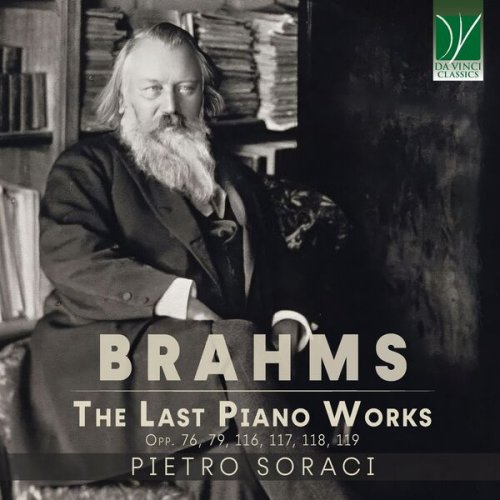
BAND/ARTIST: Pietro Soraci
- Title: Johannes Brahms: The Last Piano Works
- Year Of Release: 2026
- Label: Da Vinci Classics
- Genre: Classical Piano
- Quality: flac lossless (tracks)
- Total Time: 01:56:53
- Total Size: 437 mb
- WebSite: Album Preview
Tracklist
CD1
01. 8 Klavierstücke, Op. 76: No. 1 in F-Sharp Minor, Capriccio. Un poco agitato, in F-sharp minor
02. 8 Klavierstücke, Op. 76: No. 2 in B Minor, Capriccio. Allegretto non troppo
03. 8 Klavierstücke, Op. 76: No. 3 in A-Flat Major, Intermezzo. Grazioso
04. 8 Klavierstücke, Op. 76: No. 4 in B-Flat Major, Intermezzo. Allegretto grazioso
05. 8 Klavierstücke, Op. 76: No. 5 in C-Sharp Minor, Capriccio. Agitato, ma non troppo presto
06. 8 Klavierstücke, Op. 76: No. 6 in A Major, Intermezzo. Andante con moto
07. 8 Klavierstücke, Op. 76: No. 7 in A Minor, Intermezzo. Moderato semplice
08. 8 Klavierstücke, Op. 76: No. 8 in C Major, Capriccio. Grazioso ed un poco vivace
09. 2 Rhapsodien, Op. 79: No. 1 in B Minor, Agitato
10. 2 Rhapsodien, Op. 79: No. 2 in G Minor, Molto passionato, ma non troppo allegro
11. 7 Fantasien, Op. 116: No. 1 in D Minor, Capriccio. Presto energico
12. 7 Fantasien, Op. 116: No. 2 in A Minor, Intermezzo. Andante
13. 7 Fantasien, Op. 116: No. 3 in G Minor, Capriccio. Allegro passionato
14. 7 Fantasien, Op. 116: No. 4 in E Major, Intermezzo. Adagio
15. 7 Fantasien, Op. 116: No. 5 in E Minor, Intermezzo. Andante con grazia ed intimissimo sentimento
16. 7 Fantasien, Op. 116: No. 6 in E Major, Intermezzo. Andantino teneramente
17. 7 Fantasien, Op. 116: No. 7 in D Minor, Capriccio. Allegro agitato
CD2
01. 3 Intermezzi, Op. 117: No. 1 in E-Flat Major, Andante moderato
02. 3 Intermezzi, Op. 117: No. 2 in B-Flat Minor, Andante non troppo e con molta espressione
03. 3 Intermezzi, Op. 117: No. 3 in C-Sharp Minor, Andante con moto
04. 6 Klavierstücke, Op. 118: No. 1 in A Minor, Intermezzo. Allegro non assai, ma molto appassionato
05. 6 Klavierstücke, Op. 118: No. 2 in A Major, Intermezzo. Andante teneramente
06. 6 Klavierstücke, Op. 118: No. 3 in G Minor, Ballade. Allegro energico
07. 6 Klavierstücke, Op. 118: No. 4 in F Minor, Intermezzo. Allegretto un poco agitato
08. 6 Klavierstücke, Op. 118: No. 5 in F Major, Romanze. Andante—Allegretto grazioso
09. 6 Klavierstücke, Op. 118: No. 6 in E-Flat Minor, Intermezzo. Andante, largo e mesto
10. 4 Klavierstücke, Op. 119: No. 1 in B Minor, Intermezzo. Adagio
11. 4 Klavierstücke, Op. 119: No. 2 in E Minor, Intermezzo. Andantino un poco agitato
12. 4 Klavierstücke, Op. 119: No. 3 in C Major, Intermezzo. Grazioso e giocoso
13. 4 Klavierstücke, Op. 119: No. 4 in E-Flat Major, Rhapsody. Allegro risoluto
For Johannes Brahms the piano was never merely an instrument of work or of private confession. It was the place in which his imagination, from the years of the youthful sonatas and the great variation sets onwards, learned to measure the weight of form and the breathing of time. The dual itinerary gathered on this disc, from the 8 Klavierstücke op. 76 and the 2 Rhapsodien op. 79 to the late collections opp. 116, 117, 118 and 119, embraces the most secret and at the same time the most revealing tract of his piano production. Here there emerges a Brahms unlike the monumental master of the symphonies or the concertos, an author who concentrates within the miniature, within the apparent fragment, within the brief lyrical form, a harmonic, rhythmic and contrapuntal thought of vertiginous density. The thirty pages distributed across the two CDs thus form a great diary for piano, a book of meditations, impulses, elegies and memories, ordered by collections yet traversed by a profound spiritual unity.
The 8 Klavierstücke op. 76 mark Brahms’s return to the group of short keyboard pieces after a long season dominated by larger forms. Composed in large part during the stay in Pörtschach and welcomed with enthusiasm by Theodor Billroth, they belong to that phase which historiography has often described as the second Brahmsian maturity, when the architectural solidity of the central years is joined to an ever subtler freedom in the treatment of phrase, metre and inner colour. The four pairs of Capriccio and Intermezzo do not establish a mere alternation of characters. They set in place two poles of the same language, on the one hand urgency, rhythmic asperity and concentration of energy, on the other the inward folding of song, the penumbra of the middle voices, that gathered quality which would become the seal of the late Brahms. Already in this collection the nominal distinction remains elastic. The Capricci preserve the finesse of detail, and the Intermezzi often bear within them a concealed tension, as though every page breathed between impulse and restraint.
The 2 Rhapsodien op. 79, dedicated to Elisabeth von Herzogenberg, enlarge that world and alter its perspective. The title, accepted not without hesitation, might suggest a free and improvisatory eloquence. In reality, both pages live by a most rigorous formal control. The first, in B minor, unfolds a broader, almost epic breath, yet at its centre opens a zone of singularly recollected lyricism. The second, in G minor, proceeds with greater concentration, with a tragic thrust that leads it to a memorable synthesis. In these two scores the piano of Brahms still preserves something of the grand heroic manner, while the sonic material already appears filtered through a more meditative awareness. Gesture becomes more essential, design more deeply furrowed, the contrast between impulse and song more radical. It is as though Brahms had entrusted to the Rhapsodien the last great extrovert motion before withdrawing into a more shadowed and barer inner landscape.
That inner landscape opens fully in the four late collections. After having believed the end of his creative journey to be near, Brahms rediscovered in his final years an energy of concentration which produced, almost in a single flowering, the Fantasien op. 116, the Drei Intermezzi op. 117, the 6 Klavierstücke op. 118 and the 4 Klavierstücke op. 119. To the same season belong the works for clarinet and the final chamber masterpieces. Yet in the piano pages the voice becomes barer still. Around the composer there gathered bereavements, infirmities and farewells, and much of this music bears within it an autumnal gravity, a sense of decline inseparable from a prodigious constructive lucidity. Clara Schumann was the first reader of many of these pages, received in manuscript and welcomed with deeply moved admiration. This biographical closeness suggests the extreme degree of artistic intimacy preserved by these collections, almost as though Brahms were writing for a few eyes only and for an inwardly focused listening.
The Fantasien op. 116 occupy, within the last notebook, a position at once inaugural and problematic. The title is singular, since the collection comprises three Capricci and four Intermezzi, the same names already employed in op. 76. Yet the word Fantasien grasps something essential. Here the unity of the cycle derives from the internal circulation of gestures, keys, rhythmic figures and affective zones. The arc that stretches from the first piece to the seventh, both in D minor and of impetuous temperament, gives to the collection an almost sonata-like tension, while at the centre the three Intermezzi in E major and minor construct a broad slow zone, intimate and suspended. Brahms transforms the compact form into a succession of mental states, as though each piece were the fragment of a larger discourse left unspoken. The fifth, marked Andante con grazia ed intimissimo sentimento, carries this poetics to an extraordinarily rare degree of concentration. Nowhere else does the term intermezzo coincide with such precision with the idea of interior monologue.
In the Drei Intermezzi op. 117 the miniature reaches an almost absolute purity. Criticism has often felt them to be an autonomous triptych at the heart of the late production, and the formulation is persuasive. They are three pages intimately linked by atmosphere, movement and timbre, three meditations in which song seems to rise from the depth of the keyboard with a rocking motion, almost a word uttered sotto voce. The first bears as epigraph the verses of Herder drawn from a Scottish lullaby, and the oscillation of the line preserves its remote gesture. The whole collection may be heard as a sequence of shadowed lullabies, inhabited by tenderness and desolation alike. The second Intermezzo, in B flat minor, is the most troubled and the most secretly dramatic. The third, in C sharp minor, distils a melancholy of essential nakedness. In these pages Brahms carries to the extreme his art of inwardness, making of the middle voices, of harmonic suspensions, of small metrical displacements, the true centre of discourse.
The 6 Klavierstücke op. 118 constitute the most varied and perhaps the most perfectly balanced notebook of the late Brahms. No other collection unites with such naturalness impetus, song, memory of dance, elegiac concentration and a residual narrative thrust. The opening Intermezzo in A minor begins the cycle with a broad and passionate motion. The second, in A major, become one of the most celebrated pages in the entire piano literature, sings with a tenderness that seems to transfigure recollection into pure light. The Ballade in G minor brings the writing for a moment back to the rugged energy of the middle years. The fourth piece resumes the disquieted shadow of the intermezzo. The Romanze in F major introduces an episode of absorbed lightness. The final Intermezzo in E flat minor closes the notebook in a region of mournful grandeur. Clara Schumann, on receiving some of these pages, spoke of a music that wells up, shines forth and then constricts one through the greatness of its thought. Her phrase captures with exactness the coexistence of lyrical immediacy and constructive wisdom that governs op. 118.
With the 4 Klavierstücke op. 119 Brahms reaches his final pianistic word. The first three pages are Intermezzi, almost as though to reaffirm that this designation, in the last years, had become the most proper dwelling-place of his imagination. The first, in B minor, brings to listening a texture of descending thirds, dissonances and suspensions which Brahms himself described to Clara as music in which every bar must linger, almost as though it wished to absorb from every note the whole of its melancholy. The second transforms a restless design into an almost waltz-like parenthesis. The third, in C major, possesses an oblique, retiring grace, traversed by a subtle metrical play. Finally, the Rhapsodie in E flat major gathers together and overturns the whole journey. Initial robustness is followed by an irregular and complex trajectory, leading to a coda in E flat minor of resolute asperity. It is a memorable ending to the entire Brahmsian pianistic adventure, because it offers no pacification. It leaves the impression of a consciousness that has traversed shadow and retains its dignity intact.
Heard in the succession proposed by this double disc, the collections opp. 76, 79, 116, 117, 118 and 119 cease to be merely stations within a catalogue and assume the profile of a vast inward novel. From the still public tensions of op. 76 and the Rhapsodien to the gathered utterance of the last Intermezzi, Brahms shows how the miniature may receive the utmost complexity without forfeiting concentration, and how the piano may become at once reduced orchestra, implicit quartet, Lied without voice, confession and architecture. Here lies the fertile paradox of his late writing. The more the discourse contracts, the more the sonic world expands. Every page seems to withhold more than it declares. Every pause weighs as much as a theme. Every inner voice preserves a further thought. Across the great arc of these thirty compositions, Brahms the pianist and Brahms the constructor coincide fully, bequeathing a music that speaks softly and rules with absolute authority.
CD1
01. 8 Klavierstücke, Op. 76: No. 1 in F-Sharp Minor, Capriccio. Un poco agitato, in F-sharp minor
02. 8 Klavierstücke, Op. 76: No. 2 in B Minor, Capriccio. Allegretto non troppo
03. 8 Klavierstücke, Op. 76: No. 3 in A-Flat Major, Intermezzo. Grazioso
04. 8 Klavierstücke, Op. 76: No. 4 in B-Flat Major, Intermezzo. Allegretto grazioso
05. 8 Klavierstücke, Op. 76: No. 5 in C-Sharp Minor, Capriccio. Agitato, ma non troppo presto
06. 8 Klavierstücke, Op. 76: No. 6 in A Major, Intermezzo. Andante con moto
07. 8 Klavierstücke, Op. 76: No. 7 in A Minor, Intermezzo. Moderato semplice
08. 8 Klavierstücke, Op. 76: No. 8 in C Major, Capriccio. Grazioso ed un poco vivace
09. 2 Rhapsodien, Op. 79: No. 1 in B Minor, Agitato
10. 2 Rhapsodien, Op. 79: No. 2 in G Minor, Molto passionato, ma non troppo allegro
11. 7 Fantasien, Op. 116: No. 1 in D Minor, Capriccio. Presto energico
12. 7 Fantasien, Op. 116: No. 2 in A Minor, Intermezzo. Andante
13. 7 Fantasien, Op. 116: No. 3 in G Minor, Capriccio. Allegro passionato
14. 7 Fantasien, Op. 116: No. 4 in E Major, Intermezzo. Adagio
15. 7 Fantasien, Op. 116: No. 5 in E Minor, Intermezzo. Andante con grazia ed intimissimo sentimento
16. 7 Fantasien, Op. 116: No. 6 in E Major, Intermezzo. Andantino teneramente
17. 7 Fantasien, Op. 116: No. 7 in D Minor, Capriccio. Allegro agitato
CD2
01. 3 Intermezzi, Op. 117: No. 1 in E-Flat Major, Andante moderato
02. 3 Intermezzi, Op. 117: No. 2 in B-Flat Minor, Andante non troppo e con molta espressione
03. 3 Intermezzi, Op. 117: No. 3 in C-Sharp Minor, Andante con moto
04. 6 Klavierstücke, Op. 118: No. 1 in A Minor, Intermezzo. Allegro non assai, ma molto appassionato
05. 6 Klavierstücke, Op. 118: No. 2 in A Major, Intermezzo. Andante teneramente
06. 6 Klavierstücke, Op. 118: No. 3 in G Minor, Ballade. Allegro energico
07. 6 Klavierstücke, Op. 118: No. 4 in F Minor, Intermezzo. Allegretto un poco agitato
08. 6 Klavierstücke, Op. 118: No. 5 in F Major, Romanze. Andante—Allegretto grazioso
09. 6 Klavierstücke, Op. 118: No. 6 in E-Flat Minor, Intermezzo. Andante, largo e mesto
10. 4 Klavierstücke, Op. 119: No. 1 in B Minor, Intermezzo. Adagio
11. 4 Klavierstücke, Op. 119: No. 2 in E Minor, Intermezzo. Andantino un poco agitato
12. 4 Klavierstücke, Op. 119: No. 3 in C Major, Intermezzo. Grazioso e giocoso
13. 4 Klavierstücke, Op. 119: No. 4 in E-Flat Major, Rhapsody. Allegro risoluto
For Johannes Brahms the piano was never merely an instrument of work or of private confession. It was the place in which his imagination, from the years of the youthful sonatas and the great variation sets onwards, learned to measure the weight of form and the breathing of time. The dual itinerary gathered on this disc, from the 8 Klavierstücke op. 76 and the 2 Rhapsodien op. 79 to the late collections opp. 116, 117, 118 and 119, embraces the most secret and at the same time the most revealing tract of his piano production. Here there emerges a Brahms unlike the monumental master of the symphonies or the concertos, an author who concentrates within the miniature, within the apparent fragment, within the brief lyrical form, a harmonic, rhythmic and contrapuntal thought of vertiginous density. The thirty pages distributed across the two CDs thus form a great diary for piano, a book of meditations, impulses, elegies and memories, ordered by collections yet traversed by a profound spiritual unity.
The 8 Klavierstücke op. 76 mark Brahms’s return to the group of short keyboard pieces after a long season dominated by larger forms. Composed in large part during the stay in Pörtschach and welcomed with enthusiasm by Theodor Billroth, they belong to that phase which historiography has often described as the second Brahmsian maturity, when the architectural solidity of the central years is joined to an ever subtler freedom in the treatment of phrase, metre and inner colour. The four pairs of Capriccio and Intermezzo do not establish a mere alternation of characters. They set in place two poles of the same language, on the one hand urgency, rhythmic asperity and concentration of energy, on the other the inward folding of song, the penumbra of the middle voices, that gathered quality which would become the seal of the late Brahms. Already in this collection the nominal distinction remains elastic. The Capricci preserve the finesse of detail, and the Intermezzi often bear within them a concealed tension, as though every page breathed between impulse and restraint.
The 2 Rhapsodien op. 79, dedicated to Elisabeth von Herzogenberg, enlarge that world and alter its perspective. The title, accepted not without hesitation, might suggest a free and improvisatory eloquence. In reality, both pages live by a most rigorous formal control. The first, in B minor, unfolds a broader, almost epic breath, yet at its centre opens a zone of singularly recollected lyricism. The second, in G minor, proceeds with greater concentration, with a tragic thrust that leads it to a memorable synthesis. In these two scores the piano of Brahms still preserves something of the grand heroic manner, while the sonic material already appears filtered through a more meditative awareness. Gesture becomes more essential, design more deeply furrowed, the contrast between impulse and song more radical. It is as though Brahms had entrusted to the Rhapsodien the last great extrovert motion before withdrawing into a more shadowed and barer inner landscape.
That inner landscape opens fully in the four late collections. After having believed the end of his creative journey to be near, Brahms rediscovered in his final years an energy of concentration which produced, almost in a single flowering, the Fantasien op. 116, the Drei Intermezzi op. 117, the 6 Klavierstücke op. 118 and the 4 Klavierstücke op. 119. To the same season belong the works for clarinet and the final chamber masterpieces. Yet in the piano pages the voice becomes barer still. Around the composer there gathered bereavements, infirmities and farewells, and much of this music bears within it an autumnal gravity, a sense of decline inseparable from a prodigious constructive lucidity. Clara Schumann was the first reader of many of these pages, received in manuscript and welcomed with deeply moved admiration. This biographical closeness suggests the extreme degree of artistic intimacy preserved by these collections, almost as though Brahms were writing for a few eyes only and for an inwardly focused listening.
The Fantasien op. 116 occupy, within the last notebook, a position at once inaugural and problematic. The title is singular, since the collection comprises three Capricci and four Intermezzi, the same names already employed in op. 76. Yet the word Fantasien grasps something essential. Here the unity of the cycle derives from the internal circulation of gestures, keys, rhythmic figures and affective zones. The arc that stretches from the first piece to the seventh, both in D minor and of impetuous temperament, gives to the collection an almost sonata-like tension, while at the centre the three Intermezzi in E major and minor construct a broad slow zone, intimate and suspended. Brahms transforms the compact form into a succession of mental states, as though each piece were the fragment of a larger discourse left unspoken. The fifth, marked Andante con grazia ed intimissimo sentimento, carries this poetics to an extraordinarily rare degree of concentration. Nowhere else does the term intermezzo coincide with such precision with the idea of interior monologue.
In the Drei Intermezzi op. 117 the miniature reaches an almost absolute purity. Criticism has often felt them to be an autonomous triptych at the heart of the late production, and the formulation is persuasive. They are three pages intimately linked by atmosphere, movement and timbre, three meditations in which song seems to rise from the depth of the keyboard with a rocking motion, almost a word uttered sotto voce. The first bears as epigraph the verses of Herder drawn from a Scottish lullaby, and the oscillation of the line preserves its remote gesture. The whole collection may be heard as a sequence of shadowed lullabies, inhabited by tenderness and desolation alike. The second Intermezzo, in B flat minor, is the most troubled and the most secretly dramatic. The third, in C sharp minor, distils a melancholy of essential nakedness. In these pages Brahms carries to the extreme his art of inwardness, making of the middle voices, of harmonic suspensions, of small metrical displacements, the true centre of discourse.
The 6 Klavierstücke op. 118 constitute the most varied and perhaps the most perfectly balanced notebook of the late Brahms. No other collection unites with such naturalness impetus, song, memory of dance, elegiac concentration and a residual narrative thrust. The opening Intermezzo in A minor begins the cycle with a broad and passionate motion. The second, in A major, become one of the most celebrated pages in the entire piano literature, sings with a tenderness that seems to transfigure recollection into pure light. The Ballade in G minor brings the writing for a moment back to the rugged energy of the middle years. The fourth piece resumes the disquieted shadow of the intermezzo. The Romanze in F major introduces an episode of absorbed lightness. The final Intermezzo in E flat minor closes the notebook in a region of mournful grandeur. Clara Schumann, on receiving some of these pages, spoke of a music that wells up, shines forth and then constricts one through the greatness of its thought. Her phrase captures with exactness the coexistence of lyrical immediacy and constructive wisdom that governs op. 118.
With the 4 Klavierstücke op. 119 Brahms reaches his final pianistic word. The first three pages are Intermezzi, almost as though to reaffirm that this designation, in the last years, had become the most proper dwelling-place of his imagination. The first, in B minor, brings to listening a texture of descending thirds, dissonances and suspensions which Brahms himself described to Clara as music in which every bar must linger, almost as though it wished to absorb from every note the whole of its melancholy. The second transforms a restless design into an almost waltz-like parenthesis. The third, in C major, possesses an oblique, retiring grace, traversed by a subtle metrical play. Finally, the Rhapsodie in E flat major gathers together and overturns the whole journey. Initial robustness is followed by an irregular and complex trajectory, leading to a coda in E flat minor of resolute asperity. It is a memorable ending to the entire Brahmsian pianistic adventure, because it offers no pacification. It leaves the impression of a consciousness that has traversed shadow and retains its dignity intact.
Heard in the succession proposed by this double disc, the collections opp. 76, 79, 116, 117, 118 and 119 cease to be merely stations within a catalogue and assume the profile of a vast inward novel. From the still public tensions of op. 76 and the Rhapsodien to the gathered utterance of the last Intermezzi, Brahms shows how the miniature may receive the utmost complexity without forfeiting concentration, and how the piano may become at once reduced orchestra, implicit quartet, Lied without voice, confession and architecture. Here lies the fertile paradox of his late writing. The more the discourse contracts, the more the sonic world expands. Every page seems to withhold more than it declares. Every pause weighs as much as a theme. Every inner voice preserves a further thought. Across the great arc of these thirty compositions, Brahms the pianist and Brahms the constructor coincide fully, bequeathing a music that speaks softly and rules with absolute authority.
| Classical | FLAC / APE
As a ISRA.CLOUD's PREMIUM member you will have the following benefits:
- Unlimited high speed downloads
- Download directly without waiting time
- Unlimited parallel downloads
- Support for download accelerators
- No advertising
- Resume broken downloads