


Rutger Hoedemaekers - All The Good It Would Have Done (2026) [Hi-Res]
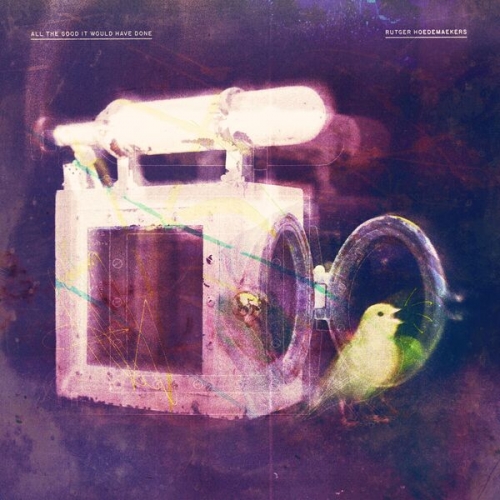
BAND/ARTIST: Rutger Hoedemaekers
- Title: All The Good It Would Have Done
- Year Of Release: 2026
- Label: Nouveau Gout
- Genre: Modern Classical, Ambient, Indonesian Gamelan
- Quality: FLAC 24-Bit/48 kHz; 16-Bit/44.1 kHz; MP3 320 kbps
- Total Time: 00:37:25
- Total Size: 196; 368 mb
- WebSite: Album Preview
Composer Hoedemaekers' musical project explores the climate crisis and humanity’s response to environmental catastrophe through the lens of classic Minimalism and chance operations. At the core of the album lies the hypothesis that uncoordinated individual actions, much like independent musical rhythms, can eventually synchronize and produce harmony out of chaos.
To manifest this concept, Hoedemaekers set aside strict compositional control and established basic algorithmic rules for an instrumental ensemble: specific sets of notes and independent tempos for each instrument, including marimba, vibraphone, trautonium, violin, trumpets, and modular synthesizer. The initial polyrhythmic cacophony, echoing Indonesian gamelan, transformed into harmonic textures through subtle, targeted adjustments of individual parts.
This conceptual framework extended to the recording process, where musicians—including LudoWic, Margaret Hermant, Bryan Senti, and Rike Huy—recorded their parts in isolation. This mirrored societal fragmentation in the face of global challenges while embracing random performance variations.
The narrative arc transitions from playful, lighthearted opening movements to a dramatic centerpiece titled after one of David Hilbert's unresolved mathematical problems, where a siren-like tone serves as an ecological warning. The final track, named after a line by poet Czeslaw Milosz, transforms that siren into a triumphant beacon of hope. The album is consciously crafted to demand active, undivided listener engagement.
Georgi Tsenov: marimba, vibraphone, glockenspiel
Tomasz Duda: flute, clarinet, bass clarinet, alto saxophone
Rike Huy: trumpet, slide trumpet, bass trumpet, flugelhorn
Thijs Lodewijk: trautonium
Bryan Senti: violin, viola
Margaret Hermant: violin
J.B. van der Wal: electric guitar
Yann Lecollaire: bass clarinet
Yair Elazar Glotman: double bass
Kurt Gerome: double bass
Maud Cassagne: vocals
Mirka Duijn: vocals
Johanneke Kranendonk: vocals
Koen-Willem Toering: vocals
Rutger Hoedemaekers: vocals, percussion, modular synth
Tracklist:
1. Rutger Hoedemaekers - Problem of the Straight Line as the Shortest Distance Between Two Points
2. Rutger Hoedemaekers - Irrationality and Transcendence of Certain Numbers
3. Rutger Hoedemaekers - Concept of a Continuous Group of Transformations Without the Assumption of the Differentiability of the Functions Defining the Group
4. Rutger Hoedemaekers - Expression of Definite Forms by Squares
5. Rutger Hoedemaekers - The General Problem of Boundary Values
6. Rutger Hoedemaekers - Proof of the Finiteness of Certain Complete Systems of Functions
7. Rutger Hoedemaekers - There Will Be No Other End of the World, There Will Be No Other End of the World
| Classical | Ambient | FLAC / APE | HD & Vinyl
As a ISRA.CLOUD's PREMIUM member you will have the following benefits:
- Unlimited high speed downloads
- Download directly without waiting time
- Unlimited parallel downloads
- Support for download accelerators
- No advertising
- Resume broken downloads