


Jun Lin Wu - Chopin, Scriabin: Études and Other Piano Works (2026)
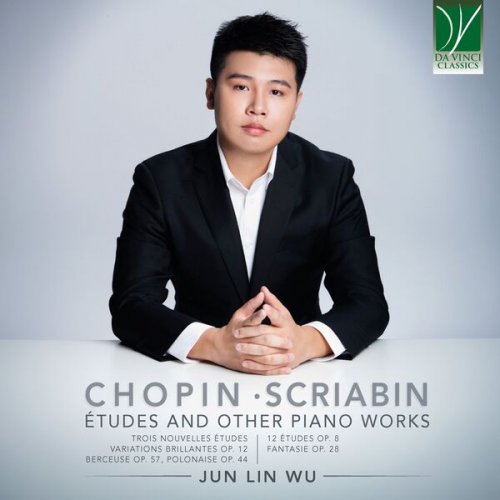
BAND/ARTIST: Jun Lin Wu
- Title: Chopin, Scriabin: Études and Other Piano Works
- Year Of Release: 2026
- Label: Da Vinci Classics
- Genre: Classical Piano
- Quality: flac lossless (tracks)
- Total Time: 01:09:07
- Total Size: 176 mb
- WebSite: Album Preview
Tracklist
01. Variations brillantes, Op. 12
02. Trois nouvelles études, posth.: No. 1 in E Minor
03. Trois nouvelles études, posth.: No. 2 in A-Flat Major
04. Trois nouvelles études, posth.: No. 3 in D-Flat Major
05. Berceuse in D-Flat Major, Op. 57
06. Polonaise in F-Sharp Minor, Op. 44
07. 12 Études, Op. 8: No. 1 in C-Sharp Major, Allegro
08. 12 Études, Op. 8: No. 2 in F-Sharp Minor, A capriccio, con forza
09. 12 Études, Op. 8: No. 3 in B Minor, Tempestoso
10. 12 Études, Op. 8: No. 4 in B Major, Piacevole
11. 12 Études, Op. 8: No. 5 in E Major, Brioso
12. 12 Études, Op. 8: No. 6 in A Major, Con grazia
13. 12 Études, Op. 8: No. 7 in B-Flat Minor, Presto tenebroso, agitato
14. 12 Études, Op. 8: No. 8 in A-Flat Major, Lento - Tempo rubato
15. 12 Études, Op. 8: No. 9 in G-Sharp Minor, Alla ballata
16. 12 Études, Op. 8: No. 10 in D-Flat Major, Allegro
17. 12 Études, Op. 8: No. 11 in B-Flat Minor, Andante cantabile
18. 12 Études, Op. 8: No. 12 in D-Sharp Minor, Patetico
19. Fantaisie in B Minor, Op. 28
To place Chopin and Scriabin side by side is not merely to trace a line of influence. It is to listen to the piano discovering, across the nineteenth century and into the threshold of modernity, that it could be more than an instrument: it could be a theatre of consciousness. Chopin gave the keyboard a new grammar of breathing, speech, hesitation and desire; Scriabin inherited that grammar and set it under another light, more fevered, more volatile, less content with lyric utterance than with transfiguration. Between them lies one of the essential histories of pianism: the passage from song made tactile to harmony made incandescent.
Chopin’s revolution was not loud. It did not announce itself by enlarging the piano into an orchestra, nor by treating virtuosity as a public athletic contest. His genius lay rather in making touch itself speak. The smallest displacement of time, the distribution of weight between melody and accompaniment, the half-lit resonance left by the pedal, the curve of an ornament: these became structural events. Technique, in Chopin, is never neutral mechanism; it is a moral discipline of sound. A scale must sing; a chord must breathe; an accompaniment must not accompany merely, but remember, console, or disturb. He transformed inherited genres – the étude, the nocturne, the mazurka, the polonaise, the variation, the fantasy – by drawing them inward. What had been a social form became psychological form.
Scriabin begins from that world. His early music is often described as Chopinesque, and the word is useful provided it is not allowed to become lazy. Scriabin does not copy Chopin as a pupil copies a master; he absorbs a set of pianistic premises and subjects them to a different metaphysical pressure. He takes Chopin’s chromatic sigh, his layered cantabile, his flexible metre, his figuration that grows from the anatomy of the hand, and drives them towards states of rapture, agitation and vertigo. The result is not Chopin in Russian costume, but Chopin’s pianism reimagined as nervous electricity. Where Chopin suspends, Scriabin inflames; where Chopin veils, Scriabin irradiates; where Chopin preserves the nobility of restraint, Scriabin courts the perilous edge of ecstasy.
The Variations brillantes, Op. 12 show Chopin at a decisive moment of stylistic negotiation. Based on the aria “Je vends des scapulaires” from Ferdinand Hérold’s Ludovic, they belong outwardly to the Parisian culture of opera heard, remembered, reduced and re-enacted at the domestic piano. The brilliant variation set was a fashionable form, designed to dazzle while offering the pleasure of recognition. Yet even here Chopin is not content with display as surface. The writing sparkles, certainly; it glitters with the ornaments, passagework and theatrical fluency expected of the style brillant. But beneath the polish lies a composer already moving beyond the decorative. The opera theme is not simply dressed in pianistic finery: it becomes a laboratory in which gesture, character and touch can be tested. This is Chopin before the full inwardness of the later works, but not before refinement. Even brilliance, in his hands, learns manners; it becomes wit, inflection, conversation.
The Trois nouvelles études, composed for the Moscheles–Fétis Méthode des méthodes, stand almost at the opposite pole. They do not thunder; they instruct by seduction. Less spectacular than the Études of Op. 10 and Op. 25, they refine the very idea of what an étude may be. The first, in F minor, makes polyrhythm a question of poise rather than arithmetic: three against four becomes a lesson in breathing two kinds of time at once. The second, in A-flat major, is more intimate still, asking the pianist to balance chordal motion, melodic emergence and supple rhythmic coordination without disturbing the line. The third, in D-flat major, turns independence of voices and articulation into a miniature art of tact. These pieces remind us that Chopin’s pedagogy was never a warehouse of technical devices. It was an education of listening. The hand is taught because the ear has made a demand.
With the Berceuse in D-flat major, Op. 57, Chopin enters the region where simplicity and complexity become indistinguishable. The piece was originally associated with the working title Variantes, and the word is revealing. This is not variation in the public, sectional sense of the early brilliant manner; it is variation as continuous blossoming, as a series of minute illuminations around a four-bar model. The ostinato bass rocks with an almost imperturbable regularity, but above it the right hand unfolds a filigree of ever more delicate transformations. Nothing seems to happen, and everything changes. The lullaby becomes a study in musical time: recurrence without stasis, ornament without excess, innocence without naivety. It is perhaps one of Chopin’s most radical works precisely because it appears so gentle. The cradle rhythm is also a metaphysical device. It holds the music in place so that the imagination may drift beyond place.
The Polonaise in F-sharp minor, Op. 44, by contrast, is a work of public bearing haunted by private unease. Chopin himself described it, in different letters, as a kind of fantasy in the form of a polonaise and as a kind of polonaise in the form of a fantasy; the ambiguity is not verbal accident but formal truth. The proud polonaise frame does not contain a simple patriotic tableau. It encloses a darker, more enigmatic space, including an obsessive ostinato passage and the astonishing apparition of a Mazurka in A major. National dance here becomes memory under pressure. The heroic rhythm is present, but its authority is unsettled; ceremonial gesture gives way to dream, interruption, and recollection. The piece is therefore not merely a polonaise enlarged. It is a drama of genre itself, a form asking what it can still mean when history and inwardness have begun to fracture its outlines.
This matters greatly for the encounter with Scriabin. For Scriabin, too, inherited forms are never empty containers. In the Twelve Études, Op. 8, published by Belaieff in 1895 after an intense process of revision, the Chopinian étude becomes the site of a new bodily and harmonic urgency. The set acknowledges the precedent of Chopin’s concert études, but everything is tightened, stretched, and made more combustible. The hand is driven to extensions, collisions, rapid changes of weight and colour; the pedal is no mere resonance but an agent of atmosphere; rhythm presses forward with a nervous insistence. If Chopin had made the étude sing, Scriabin makes it burn.
The sequence of Op. 8 can be heard as a gallery of concentrated psychological states. The C-sharp major opening étude glows with a bright, almost metallic lyricism. The F-sharp minor second étude, marked A capriccio, con forza, is already more unstable, its energy springing from the tension between whim and compulsion. The B minor third, tempestoso, hurls the pianist into an elemental rhetoric of storm; the B major fourth offers a deceptive piacevole, a smile with tremors beneath the surface. Brioso, con grazia, presto tenebroso, lento, alla ballata, andante cantabile: these are not merely tempo or character indications, but invitations to inhabit rapidly changing temperatures of the soul. The famous D-sharp minor twelfth étude, Patetico, crowns the set not by summarising it, but by exposing its most recognisable nerve: aspiration forced through resistance, melody armoured in octaves, passion made almost architectural by repetition.
Yet Scriabin’s relationship to Chopin is at its most interesting where resemblance begins to fail. Chopin’s chromaticism frequently deepens tonal feeling by delaying, colouring or intensifying return. Scriabin increasingly treats tonal gravity as something to be resisted, diffused, or rendered implicit. Even in these earlier works, one senses the future composer of altered harmonic fields and ecstatic suspension. The music has roots, but it dreams of levitation. Its lyricism is rarely content with song alone; it wants flight, dissolution, a release from the very keyboard that produces it. This is why Scriabin’s pianism can feel at once indebted and rebellious. Chopin gives him the instrument as an inward voice; Scriabin asks whether that voice might become flame.
The Fantasie in B minor, Op. 28 is the natural culmination of such a programme. Written in 1900, a substantial single movement in sonata form, it stands between the Third and Fourth Sonatas and belongs to the period in which Scriabin’s early inheritance is being transformed into a more personal dramatic language. Its opening does not simply state a key; it circles, withholds, and broods. The textures are dense, the voicing demanding, the rhetoric expansive. The work’s fantasy is not caprice but compulsion: sonata form is present, yet it is pushed by an imagination impatient with symmetry. The lyrical second subject rises with consoling breadth, but consolation in Scriabin is never innocent. It is already charged with longing for exaltation. By the time the music drives towards its culminating gestures, one hears not a Chopinian fantasy translated into another idiom, but a fantasy after Chopin: more obsessive, more vertically saturated, more desirous of transcendence.
Taken as a whole, the programme suggests less a direct passage from Chopin to Scriabin than a gradual alteration in the very idea of pianistic expression. In Chopin, the keyboard becomes a medium of inflection: it sings, remembers, hesitates, and shapes time through touch. The brilliance of the early variation set, the concentrated refinement of the Nouvelles études, the suspended figuration of the Berceuse, and the troubled ceremonial grandeur of the F-sharp minor Polonaise all belong to a world in which virtuosity is absorbed. Nothing is merely decorative; even the most ornamental writing has a structural and expressive purpose.
Scriabin takes up many of these premises, but the temperature changes. The étude remains a place where technical difficulty and poetic meaning are inseparable, yet in Op. 8 the Chopinian inheritance is pressed towards greater compression, urgency and instability. Melody is no longer simply sustained by harmony; it seems to strain against it. Figuration no longer only embellishes the line; it agitates the entire texture from within. By the time we reach the Fantasie in B minor, the piano has become the site of a more unsettled drama, one in which lyricism, aspiration and harmonic tension are drawn into a single, restless continuum.
What unites the two composers is their refusal to treat the piano as a neutral vehicle. For both, the instrument has its own laws, its own illusions, its own way of making time audible through resonance and decay. Their difference lies not in the seriousness of their ambition, but in the direction of that ambition. Chopin turns the inherited forms of his age inward, refining them until gesture becomes voice and voice becomes memory. Scriabin begins from that inwardness and intensifies it, seeking in the same instrument a more visionary and unstable field of experience.
| Classical | FLAC / APE
As a ISRA.CLOUD's PREMIUM member you will have the following benefits:
- Unlimited high speed downloads
- Download directly without waiting time
- Unlimited parallel downloads
- Support for download accelerators
- No advertising
- Resume broken downloads