


Benjamin Bernstein, Natalia Morozova - Bridge, Britten: Chamber Music with Viola (2026)
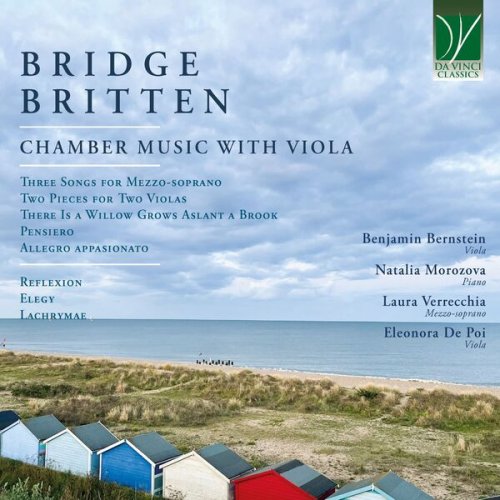
BAND/ARTIST: Benjamin Bernstein, Natalia Morozova
- Title: Bridge, Britten: Chamber Music with Viola
- Year Of Release: 2026
- Label: Da Vinci Classics
- Genre: Classical
- Quality: flac lossless (tracks)
- Total Time: 01:02:51
- Total Size: 244 mb
- WebSite: Album Preview
Tracklist
01. Three Songs, H. 76: No. 1, Far, Far from Each Other – Andante moderato
02. Three Songs, H. 76: No. 2, Where Is It That Our Soul Doth Go? – Adagio ma non troppo
03. Three Songs, H. 76: No. 3, Music, When Soft Voices Die – Andante moderato
04. Pensiero - Andante moderato, H. 53
05. Allegro appassionato, H. 82
06. Two Pieces, H. 101: No. 1, Lament
07. Two Pieces, H. 101: No. 2, Caprice
08. There Is a Willow Grows Aslant a Brook, H. 173
09. Reflection
10. Elegy
11. Lachrymae, Reflections on a Song of Dowland, Op. 48
When Frank Bridge and his wife Ethel went to bid farewell to Benjamin Britten on 29 April 1939, shortly before his train departed for Southampton, where he would board a ship for America, Bridge presented him with his treasured Giussani viola. He knew he would probably never see his favorite composition pupil again. From the age of 18, Britten had studied composition privately with Bridge while officially attending the Royal College of Music under John Ireland. Their relationship extended far beyond purely musical matters. The elder composer became both a friend and a father figure, helping Britten cope with his loneliness in London. One of Britten’s first major works was the Variations on a Theme of Frank Bridge for string orchestra, a testament to the deep artistic bond he shared with his mentor. The viola was Bridge’s professional instrument. Although he was also a pianist, his greatest achievements as a performer came as a member of a string quartet. Britten, meanwhile, was known throughout his life as an accomplished pianist, performing both as a duo partner and accompanist to his companion, Peter Pears, as well as to many of the leading musicians of his time. Yet from childhood he had been deeply fond of the viola, studying the instrument with Audrey Alston, a friend of his mother and a member of the Norwich Quartet. Alston, who was herself a friend of Bridge, introduced the young Britten to the master. Although Benjamin never performed publicly as a violist, he continued to play the instrument with pleasure throughout his life. Born in Brighton on 26 February 1879, Frank Bridge studied composition at the Royal Academy of Music. He initially earned his living as an orchestral and chamber musician before becoming a full-time composer under the patronage of Elizabeth Sprague Coolidge. An independent-minded artist, Bridge remained somewhat isolated within the Edwardian British musical world, being far more receptive to continental innovations, particularly French music. He composed symphonic works, ballets, and chamber music, including The Sea, Summer, and Lament, as well as two piano trios, four string quartets, a string sextet, and numerous songs.
Paradoxically, his original compositions for viola are relatively few. The three songs for mezzo-soprano, viola, and piano, written at the end of 1906 and the beginning of 1907, follow Brahms’s path through this marvelous tonal combination. The poems all deal with death and exile: Far, Far from Each Other (text by Matthew Arnold), Where Is It That Our Soul Doth Go? (Heinrich Heine, translated by K. F. Kroecker), and Music, When Soft Voices Die (Percy Bysshe Shelley). The last piece had originally been written in 1903 in an earlier version, in a different key, and for cello instead of viola. The songs received their first performance on 9 December 1908 at the Broadwood Concert Rooms, with Bridge at the piano. The contralto was Ivy Sinclair, Bridge’s sister-in-law, and the violist was Audrey Ffoulkes (Alston), who would give the première of the Pensiero and Allegro appassionato a year later. Pensiero and Allegro appassionato for viola and piano were published in 1908 by Stainer & Bell in the Viola Library series, edited by Lionel Tertis. The former was written in 1905 and the latter in 1907. These works reflect the two principal sides of Bridge’s musical personality: on the one hand, the elegiac, fragmented, and harmonically ambiguous style; on the other, the passionate, broad, and energetic writing. The Allegro appassionato bears many similarities to the introduction and exposition of the Phantasie Piano Trio, composed in the same year. The Lament and Caprice for two violas were written in 1911 and first performed at Aeolian Hall by Lionel Tertis and the composer. The great English violist would become one of the first internationally renowned soloists of this long-neglected instrument. He commissioned or inspired many English composers to write for the viola, among them Arnold Bax, Arthur Bliss, and William Walton. Following the première, all the performing material, as well as the original manuscript, was lost, leaving only sketches preserved in the library of the Royal College of Music. The Lament is almost complete and was prepared for publication in 1981, while the Caprice was reconstructed by Simon Rowland-Jones in 2018, with only minor interventions needed to connect the surviving fragments.
Here again we find a striking contrast between the mourning character of the Lament and the almost Mendelssohnian lightness of the Caprice, a characteristic feature of Bridge’s musical language. Unfortunately, Bridge never completed the viola sonata he began in 1935. Only sketches of an unfinished first movement survive. He died in Eastbourne on 10 January 1941, before Britten returned to England. Benjamin Britten was born in Lowestoft on 22 November 1913. His musical talent was evident from early childhood. He would establish himself as one of England’s greatest composers, achieving immense international success, with his opera Peter Grimes becoming a major classic of the twentieth-century repertoire. Above all, Britten was a composer for the voice. As founder of the English Opera Group, he sought to create the conditions for a revival of English opera, which had remained largely insignificant throughout the nineteenth century and the first half of the twentieth. To this end, he assembled a close circle of singers and instrumentalists. His lifelong partnership with the tenor Peter Pears inspired many vocal works in a wide variety of forms and settings. Other important collaborations also shaped his output: with the harpist Ossian Ellis, the guitarist Julian Bream, and the cellist Mstislav Rostropovich. These partnerships gave rise to numerous instrumental masterpieces, including a suite for solo harp, a sonata for cello and piano, three suites for solo cello, the Cello Symphony, and three string quartets. Nonetheless, Britten’s outspoken pacifism and his homosexuality often left him feeling alienated from British society. Although he maintained close relations with members of the Royal Family, he tried to spend as little time as possible in London, never severing his ties with his native Suffolk. There, together with Peter Pears, he founded the Aldeburgh Festival, which would become one of the world’s leading musical festivals. Britten’s arrangement of Bridge’s ballet There Is a Willow Grows Aslant a Brook—inspired by Gertrude’s narration of Ophelia’s death in Hamlet (Act IV, Scene 7)—reveals the deep bond between master and pupil. The music is highly atmospheric and vividly descriptive, closely following Shakespeare’s text. Britten attended a London performance of the ballet by the Camargo Company in December 1932. A few days after receiving the score from Bridge, he embarked on a reduction of the work for their shared instrument, the viola, and piano. Britten’s attachment to the piece is also evident in the Variations on a Theme of Frank Bridge, where it appears as a quotation in the Fugue. In 1948, with the blessing of Ethel Bridge, the composer’s widow, Britten also prepared a reduced orchestration of the ballet for the Aldeburgh Festival.
Reflexion and Elegy are two early works written in 1930, while Britten was still living in his parents’ home in Lowestoft, Suffolk. In them, the young composer expresses his intimate and troubled thoughts after a difficult experience at college and before beginning a new life in London. His affinity with the viola as a deeply personal medium is already apparent. In Reflexion, the influence of Bridge—especially of his Second Piano Trio—is unmistakable. Yet the mastery of form and harmony displayed by such a young composer is remarkable. Elegy was written the day after Britten left school. In his diary he noted: “I didn’t think I should be sorry to leave.” Both works were published only after his death. Britten’s only official work for viola is Lachrymae, Op. 48, commissioned by the great Scottish virtuoso William Primrose. It was written and first performed at Aldeburgh in 1950, with Britten himself at the piano. Britten often attracted some of the finest performers of his time to his festival by promising them works specially composed for the occasion. Having neglected the piece while occupied with his opera Billy Budd, Britten received a phone call from Primrose asking when he might expect the score. Britten replied that it was already in the mail—then proceeded to write the work overnight. Lachrymae is a tribute to one of Britten’s favorite English composers, John Dowland. Its title echoes several works written for viol consort. The ten variations do not present the theme at the outset; instead, each explores sharply contrasting atmospheres and emotions through a variety of instrumental techniques, including pizzicato, chords, and harmonics. Britten bases the work not on a single theme but on two related ideas, with the original Dowland melody emerging clearly only at the very end, providing a deeply moving conclusion. Britten would pay tribute to Dowland once again in 1963 with the Nocturnal, Op. 70, for guitar, written for Julian Bream. In the final year of his life, he also arranged the piano part of Lachrymae for string orchestra at the request of Cecil Aronowitz. Benjamin Britten died in Aldeburgh on 4 December 1976 leaving an indelebile mark on twentieth century music.
| Classical | FLAC / APE
As a ISRA.CLOUD's PREMIUM member you will have the following benefits:
- Unlimited high speed downloads
- Download directly without waiting time
- Unlimited parallel downloads
- Support for download accelerators
- No advertising
- Resume broken downloads