


Studio G - Nature's World (1982)
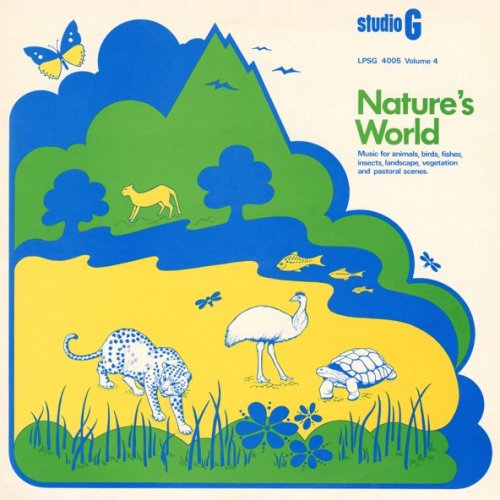
BAND/ARTIST: Studio G
- Title: Nature's World
- Year Of Release: 1982
- Label: Studio G
- Genre: Electronic
- Quality: mp3 320 kbps / flac lossless (tracks)
- Total Time: 00:42:20
- Total Size: 101 / 199 mb
- WebSite: Album Preview
Tracklist
01. Flower Garden
02. Aquarium
03. Dewdrops
04. By The Shore
05. Pastoral Mist
06. Mirage
07. Pilot Bird
08. Stalking Prey
09. Star Blossom
10. Catacombs
11. Raindrops
12. Furs And Feathers
13. Arctic Wastes
14. Bird Sanctuary
15. Mountain Currents
16. Swirling Clouds
17. Busy Bodies
18. Volcanic Journey
19. Jumbo Jive
20. Micro Life
Library records were never meant for the likes of me. They went out to producers and film editors who needed half a minute of something for a heron on a riverbank; what followed on the side was nobody’s concern. So there’s a mischievous pleasure in giving Nature’s World the treatment it was never built for: needle down at the outer edge, a decent chair, no programme to fill, twenty cues in the order Studio G pressed them in 1982.
Studio G was John Gale’s library, a London operation that later ran from a village outside Northampton. Its early singles chased the mod end of the sixties, while the themed albums that followed were pressed for the television trade and never reached the shops. This one, catalogued LPSG 4005, was billed as The Electro Quartet and offered music for animals, birds, fish, insects, vegetation, and pastoral scenes. The sleeve doesn’t say who the quartet were. It does name the writers. That’s the detail that makes vinyl the right way in: James Harpham composed every cue on Side A, James Asher every cue on Side B—two composers, one side apiece.
Library music it is, from first cue to last, with synth beds running under every one of them. Britain has given this field plenty. TONTO, co-built by London-born Malcolm Cecil after his days as house bassist at Ronnie Scott’s, remains my clearest example of where ideas and technology can take it.
Harpham’s pastoral streak runs deep. He wrote and arranged nearly all of The Wooden O’s only album, a record that borrowed its title from a 1584 Elizabethan songbook. Jazz Dispensary clearly has a soft spot for him: no composer appears as often on last year’s Dream a Dream with Studio G: Cratedigger’s Archive (1970–2009), where ‘Flower Garden’ and ‘Star Blossom’ both appear. That helps explain why this album got the full reissue.
He takes twelve cues to Asher’s eight, every one a miniature, with ‘By The Shore’ the shortest thing on the record. ‘Flower Garden’ opens the side with soulful AOR. ‘Aquarium’ is a lovely piece, though it sounds like the foundation for something greater to come; much the same could be said of most cues in this category. ‘Dewdrops’ plays like the music to a comedy sketch. ‘Pilot Bird’ keeps putting Phil Collins in my head, like the intro to a classic. Heard back to back, the brevity becomes the pleasure: a scene sets, does its work, steps aside.
Turn the record over and the scale changes. Asher’s cues are longer-limbed. His side runs from the planet’s grandest features to its tiniest, opening in ‘Arctic Wastes’ on a deep, fluttering church organ, as if scoring a remake of Fritz Lang’s Metropolis. ‘Mountain Currents’ feels like a complete track. Edgy, too: dare I say Doctor Who? On ‘Swirling Clouds’ I keep waiting for vocals to kick in. They never do. ‘Busy Bodies’, the longest of all twenty, is the best thing here, a bedroom b-boy break in the making. I love it. ‘Jumbo Jive’ is definitely synth pop. ‘Micro Life’ then closes the side at the smallest scale of all.
Asher came up as a studio engineer and kept surprising company, playing drums on two tracks of Pete Townshend’s Empty Glass in 1980, ‘Jools and Jim’ and ‘Keep On Working’. Gale’s backing went further. When Asher launched his own recording career with The Great Wheel, the UK release came out on Lumina Music, a label the two founded together. The percussion-led world music records followed through the nineties.
Ten years in, Craft Recordings’ Jazz Dispensary imprint returns Nature’s World to vinyl for the first time since 1982, on Terratopia splatter in green, yellow, and blue. Originals, cut and pressed at Nimbus, are scarce: on Discogs, collectors wanting a copy outnumber those holding one by five and a half to one. My one gripe is the billing. The reissue goes out under Studio G alone, crediting a publisher with a performance. The Electro Quartet may well have been a name of convenience, but it was the name on the 1982 sleeve. I’d have kept it.
Forty-four years after it hit the trade, Nature’s World reaches listeners it was never meant for. Begin in Harpham’s garden; Asher’s ice and fire are waiting on the other side.
Electronic | FLAC / APE | Mp3
As a ISRA.CLOUD's PREMIUM member you will have the following benefits:
- Unlimited high speed downloads
- Download directly without waiting time
- Unlimited parallel downloads
- Support for download accelerators
- No advertising
- Resume broken downloads