


Elia Guglielmo, Raffaele Impagnatiello, Chiara Pavesi - Rare Italian Chamber Music for Flute and Piano (2026)
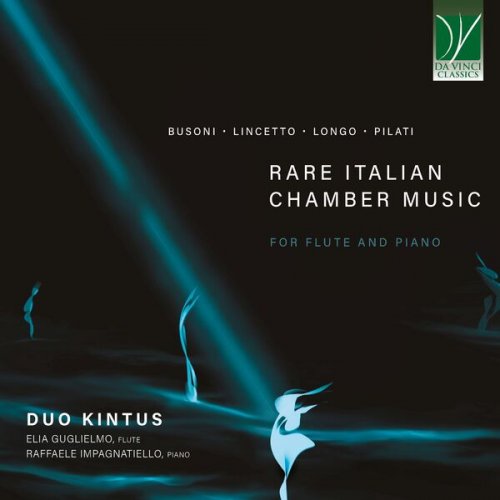
BAND/ARTIST: Elia Guglielmo, Raffaele Impagnatiello, Chiara Pavesi
- Title: Rare Italian Chamber Music for Flute and Piano
- Year Of Release: 2026
- Label: Da Vinci Classics
- Genre: Classical
- Quality: flac lossless (tracks)
- Total Time: 01:06:01
- Total Size: 258 mb
- WebSite: Album Preview
Tracklist
01. Divertimento, Op. 52, BV 285
02. Sonatina: I. Allegro spigliato
03. Sonatina: II. Andante elegiaco
04. Sonatina: III. Allegro ironico e grottesco
05. Albumblatt in E Minor
06. Suite, Op. 68: I. Allegro moderato
07. Suite, Op. 68: II. Andantino
08. Suite, Op. 68: III. Vivace
09. Duo in E Minor, Op. 43
10. Sonata, Op. 38: I. Allegro moderato
11. Sonata, Op. 38: II. Lento e sostenuto e dolce
The history of the flute in Italy between the nineteenth and twentieth centuries often proceeds along lateral paths. Beside the great French repertory, which transformed the modern transverse flute into an instrument of elegance and colour, there exists a more discreet Italian line, marked by chamber culture and by the tension between song and form. The programme of this disc reconstructs that line through Ferruccio Busoni, Adriano Lincetto, Alessandro Longo and Mario Pilati, setting their works in a sequence that traverses almost a century of writing for flute. The itinerary begins with Busoni and returns to him several times, a hinge figure between Italy and Germany, between nineteenth-century virtuosity and twentieth-century utopia; it then receives the Neapolitan measure of Longo, the modern limpidity of Pilati and the dry irony of Lincetto. What emerges is a small alternative history of the Italian flute, attentive to the quality of the line, to the breathing of discourse, and to the nobility of a chamber dialogue in which the keyboard always assumes a structural role.
Busoni was an artist of multiple identity. Born in Tuscany, raised between Trieste, Vienna, Graz and Leipzig, and finally rooted in Berlin, he brought into his music a dual fidelity, Italian in melodic imagination and German in constructive rigour. His aesthetic reflection, culminating in the idea of a new classicism, led him to seek limpid forms, capable of receiving the future without severing their relation to Bach, Mozart and Liszt. In this perspective the flute assumes for him a particular value. As an instrument of lightness and clarity, it tempers the density of thought with a mobile, almost Apollonian timbre.
The Divertimento op. 52 BV 285, conceived for flute and small orchestra and presented here in the piano reduction by Kurt Weill, belongs to the late Busonian workshop and bears the dedication to Philippe Gaubert, a central name in the French flute school. Busoni looks to the France of the modern transverse flute and filters that tradition through a formal design of severe elegance. In the Divertimento the title denotes clarity of proportion, measure of gesture and pleasure in construction. The opening, animated by virtuosic energy, entrusts to the flute an agile and luminous line, while the piano, in the reduction by Weill, preserves the memory of the original scoring through writing at once compact and transparent. The central cantabile section broadens the breath and introduces a more sensuous hue, close to the world of the late instrumental pages by Busoni. The return of the brilliant impulse leads to a close of lucid vivacity. The presence of Weill, a pupil of Busoni in Berlin, adds a further historical value. The transcription restores to the duo a new chamber functionality and bears witness to the passage of a lesson between master and disciple.
The Albumblatt in E minor offers a more intimate countenance of Busoni. Its alternative destination for violin or flute confirms the lyrical nature of the page, built upon gathered cantability and an essential pianistic accompaniment. The title, dear to the Romantic tradition of the album leaf, suggests private writing. The melodic design proceeds with reserve, the key of E minor lends the piece a tempered shadow, and every inflection appears governed by a superior sense of proportion. In this small space the flute finds a meditative voice, less theatrical than in the Divertimento, closer to the poetry of personal memory. The Duo in E minor for two flutes and piano op. 43, by contrast, returns the listener to the youthful season of the composer. Written during the period of study with Wilhelm Mayer in Graz, it already reveals a surprising autonomy of the keyboard and an early contrapuntal taste. The two flute parts proceed like sister voices, intertwined and differentiated, while the piano directs the design. In this brief page one glimpses the young Busoni learning the discipline of form and at the same time transforming it into conversation.
The Sonatina by Adriano Lincetto introduces a clear distance of language and climate. Pianist, composer and teacher associated with the Paduan milieu, Lincetto belongs to a generation for which modernity coexisted with clarity of gesture. His writing for flute favours clean profiles, lively articulations and an irony never excessive. The Sonatina in three movements offers an effective compendium of these traits. Allegro spigliato immediately sets forth a mobile, dry character, built upon brief phrases and rapid dialogue with the piano. Andante elegiaco carries the discourse into a zone of greater inwardness. The flute sings with measure, the piano defines a sober harmonic field, and the elegy remains contained within a frame of expressive modesty. Allegro ironico e grottesco closes with a sharper physiognomy. Incisive rhythms, shifts of character and deliberately angular accents give the sonatina a lively and slightly mocking conclusion, the sign of an Italian modernity inclined towards intelligent lightness.
Alessandro Longo belongs to another genealogy. His figure is indelibly linked to the rediscovery of Domenico Scarlatti, whose keyboard sonatas he ordered and disseminated in an edition that long determined their reception. Behind the musicologist and editor there lives a composer of solid Neapolitan formation, capable of joining instrumental discipline with melodic taste. The Suite op. 68 for flute and piano is born of this equilibrium. Its three movements reveal a conception close to the formative measure of cultivated domestic music. Longo treats the flute as an elegant and clearly profiled voice, entrusting to it phrases of almost vocal clarity, while the piano sustains the discourse with order and discreet harmonic density. In half-light one perceives the double soul of the author, that of the educator and that of the composer. The Allegro moderato of the Suite op. 68 establishes from the first bars a serene classicism, made of proportioned periods and balanced dialogue between the two instruments. The writing favours measured cantability, in which every inciso seems predisposed to response and variation. The Andantino concentrates the page in a more intimate zone. Here the flute assumes an almost confidential tone, and the piano draws around the line a harmonic fabric simple, yet rich in grace. In the concluding Vivace the form grows lighter, the rhythm gains impetus, and the suite reveals its bond with an instrumental civilisation that looks to tradition with naturalness. Its music testifies to an Italian current capable of absorbing German and French models within a vigilant and firmly chamber-like language.
The Sonata op. 38 by Mario Pilati closes the programme with the broadest formal breath. Pilati was one of the most promising talents of the Italian generation between the two wars. Trained in Naples, then active also in Milan within an environment in which Pizzetti, Casella, music criticism and publishing coexisted, he elaborated a personal language, nourished by neoclassicism, Mediterranean memory and European openness. His early death interrupted a trajectory already rich in symphonic, chamber and vocal works; the Sonata for flute and piano remains one of the happiest documents of his maturation. The bond with Elizabeth Sprague Coolidge, to whom the score expresses gratitude, places the page within an international network of chamber patronage and dissemination. Italian musical culture appears here projected beyond its own borders, in dialogue with a concert culture that sought new repertories for wind instruments and piano. The opening Allegro moderato of the sonata by Pilati unites melodic amplitude and constructive clarity. The flute sets forth a flexible song, French in its breath through elegance of phrasing and timbral transparency, while the piano articulates the harmonic path with firmness. The form preserves a solid framework, and the surface lives through subtle modulations, modal colours and a cantability that maintains full control. The second movement, Lento e sostenuto e dolce, constitutes the poetic centre of the work. The title accumulates three affective indications of great precision, slowness, support and sweetness, and the music translates them into a discourse of gathered intensity. The flute appears as a pure voice, suspended above a piano that breathes with breadth, while the harmony opens zones of chiaroscuro and melancholy. Lievemente mosso concludes the sonata in a more mobile light. The movement possesses rhythmic grace, elegance of design and a subtle dancing energy. Pilati entrusts the close to a refined equilibrium between impetus and measure.
Viewed as a whole, the disc traces a significant map of Italian music for flute and piano. Busoni appears in three different ages, as young contrapuntist, author of a lyrical album leaf and late master capable of transforming the flute into a vehicle of new classicism. Longo represents the continuity of the Neapolitan school and the ideal of a chamber form educated by song. Pilati carries this tradition into a more European modernity, marked by French impressions, neoclassical limpidity and an already fully twentieth-century harmonic thought. Lincetto adds a more recent voice, ironic, concise, bound to an idea of the sonatina as agile and intelligent form. The flute crosses these pages assuming different identities, instrument of grace, confession, discipline, wit and light. The piano, constant partner, becomes in turn reduced orchestra, argumentative bass, harmonic fabric and rhythmic machine. The strength of the programme lies in its capacity to restore continuity to a dispersed repertory. Within works of differing dimensions there emerges a single poetic line, the desire to make of the flute an Italian voice of modernity, capable of speaking with measure, intelligence and luminous elegance.
| Classical | FLAC / APE
As a ISRA.CLOUD's PREMIUM member you will have the following benefits:
- Unlimited high speed downloads
- Download directly without waiting time
- Unlimited parallel downloads
- Support for download accelerators
- No advertising
- Resume broken downloads