


Paul Mauriat - Volume 1 - le grand orchestre de Paul Mauriat (1965) [Hi-Res]
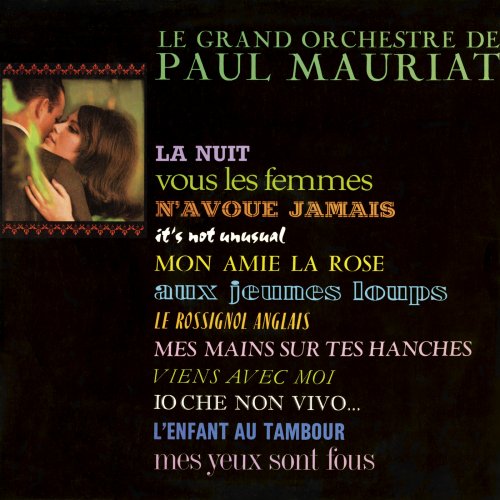
BAND/ARTIST: Paul Mauriat
- Title: Volume 1 - le grand orchestre de Paul Mauriat
- Year Of Release: 1965
- Label: Mercury Music Group
- Genre: Easy Listening
- Quality: FLAC (tracks) 24/96
- Total Time: 00:27:12
- Total Size: 579 MB
- WebSite: Album Preview
Tracklist:
01. Paul Mauriat - La nuit (2:21)
02. Paul Mauriat - Vous les femmes (2:04)
03. Paul Mauriat - N'avoue jamais (2:03)
04. Paul Mauriat - It's Not Unusual (2:15)
05. Paul Mauriat - Mon amie la rose (2:05)
06. Paul Mauriat - Aux jeunes loups (2:21)
07. Paul Mauriat - Le rossignol anglais (2:00)
08. Paul Mauriat - Mes mains sur tes hanches (2:16)
09. Paul Mauriat - Viens avec moi (2:14)
10. Paul Mauriat - Io che non vivo… (2:47)
11. Paul Mauriat - L'enfant au tambour (2:35)
12. Paul Mauriat - Mes yeux sont fous (2:17)
Paul Mauriat was a French conductor.
Born in Marseille and raised in Paris, he began conducting his own orchestra during World War II. In the 1950s, he worked and toured with at least two famous French singers: Charles Aznavour and Maurice Chevalier.
He gained widespread recognition after his 1968 instrumental arrangement of "L’Amour est bleu" ("Love Is Blue")—originally composed by André Popp—topped the charts in the United States. Paul Mauriat and his orchestra enjoyed immense popularity in Japan and South Korea.
Paul Mauriat passed away in Perpignan at the age of 81.
A Brief History of Paul Mauriat
Paul Mauriat was born and raised in Marseille, France. His father, a postal inspector, was an enthusiast of classical piano and violin. Mauriat began his musical journey at the age of four and entered the Paris Conservatory at ten; however, by seventeen, he had developed a passion for jazz and popular music. During World War II, he began leading a dance band and touring Europe with musical ensembles. In the 1950s, he became a music director and toured with renowned French singers such as Charles Aznavour and Maurice Chevalier.
In 1957, Mauriat released his first EP—a four-track record issued by RGM. Between 1959 and 1964, he recorded numerous albums for the Bel-Air label under the name "Paul Mauriat et Son Orchestre." He also utilized various pseudonyms—such as Richard Audrey, Nico Papadopoulos, Eduardo Ruo, and Willy Twist—to better tailor his sound and appeal to the international market. During this period, Paul Mauriat also released several recordings with Les Satellites, creating harmonious vocal arrangements for albums such as *Slow Rock et Twist* (1961), *À Malypense* (1962), and *Les Satellites Chantent Noël* (1964).
Mauriat composed music for numerous French films (also released via the Bel-Air label), including *Un Taxi pour Tobrouk* (1961), *Horace 62* (1962), and *Faites sauter la banque!* (1964).
He wrote his first songs in collaboration with André Pascal. In 1958, they won the *Le Coq d’or de la Chanson Française* award for "Rendez-vous au Lavandou." Using the pseudonym Del Roma, Paul Mauriat achieved his first international hit with "Chariot," a song he composed in collaboration with friends Franck Pourcel (co-composer), Jacques Plante (French lyrics), and Raymond Lefèvre (orchestrator). In the US, the song was recorded as "I Will Follow Him" by Little Peggy March and reached number one on the Billboard charts across all genres for three weeks in 1963. In 1992, the song gained fame through the film *Sister Act*, starring Whoopi Goldberg. More recently, Eminem sampled a segment of the song in his track "Guilty Conscience."
Between 1967 and 1972, he wrote numerous songs for singer Mireille Mathieu—such as "Mon Crédo" (1,335,000 copies sold), "Viens dans ma rue," "La Première Étoile," and "Géant"—and contributed to the repertoires of other artists, including Charles Aznavour, for whom he provided 130 songs. In 1965, he founded *Le Grand Orchestre de Paul Mauriat* and, over the next 28 years, released hundreds of recordings and compositions under the Philips label. In 1994, he signed with the Japanese record company Pony Canyon, where he re-recorded many of his greatest hits and composed new works. Mauriat recorded many of these albums in both Paris and London, often employing English classical musicians for the sessions.
In 1968, his instrumental cover of "L'Amour Est Bleu" ("Love Is Blue")—originally written by André Popp and Pierre Cour—topped the charts in the United States, holding the number-one spot for five weeks. Two other Paul Mauriat singles also charted in the US: "Love in Every Room" and the theme from the film *Chitty Chitty Bang Bang*. "Love Is Blue" marked the first time a French-recorded single had reached number one on the Billboard charts since The Tornados achieved the feat with "Telstar" in 1962. Following the success of the song and the accompanying album, *Blooming Hits*, Mauriat continued to arrange and record instrumental versions of popular songs from around the world.
In 1969, Paul Mauriat embarked on his first world tour with *Le Grand Orchestre*, performing in countries such as the US, Canada, Japan, South Korea, and Brazil, as well as other parts of Latin America.
In 1974, Mauriat released an album that showcased a more personal musical expression. It featured his signature "Mauriat-style" interpretations of classical masterpieces, such as Bach's "Toccata and Fugue in D Minor" and Pachelbel's "Canon." For decades, several of Paul Mauriat's works served as musical themes for Soviet television programs and short films—such as the 1977 animated film *Polygon*, *In the World of Animals* (*V mire zhivotnykh*), and *Kinopanorama*—among others.
Download Link Isra.Cloud
Paul Mauriat - Volume 1 - le grand orchestre de Paul Mauriat (1965) [Hi-Res]
My blog
Paul Mauriat - Volume 1 - le grand orchestre de Paul Mauriat (1965) [Hi-Res]
My blog
As a ISRA.CLOUD's PREMIUM member you will have the following benefits:
- Unlimited high speed downloads
- Download directly without waiting time
- Unlimited parallel downloads
- Support for download accelerators
- No advertising
- Resume broken downloads