


Danilo Mascetti - Diabelli on Broadwood - Beethoven's Op. 120 & Op. 126 (2026)
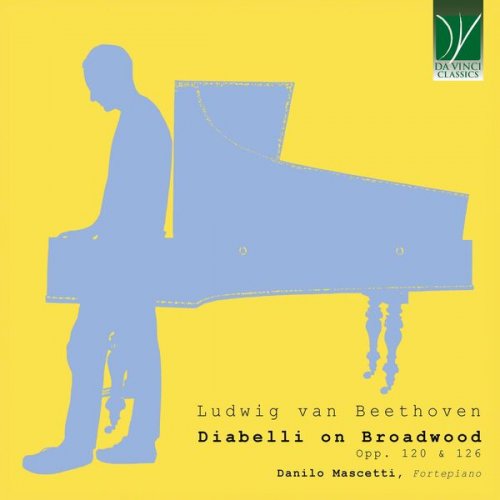
BAND/ARTIST: Danilo Mascetti
- Title: Diabelli on Broadwood - Beethoven's Op. 120 & Op. 126
- Year Of Release: 2026
- Label: Da Vinci Classics
- Genre: Classical Piano
- Quality: flac lossless (tracks)
- Total Time: 01:08:14
- Total Size: 272 mb
- WebSite: Album Preview
Tracklist
01. Diabelli Variations, Op. 120: No. 1, Theme. Vivace
02. Diabelli Variations, Op. 120: No. 1, Var. 1 Alla marcia maestoso
04. Diabelli Variations, Op. 120: No. 3, Var. 3 L’istesso tempo
05. Diabelli Variations, Op. 120: No. 4, Var. 4 Un poco più vivace
06. Diabelli Variations, Op. 120: No. 5, Var. 5 Allegro vivace
07. Diabelli Variations, Op. 120: No. 6, Var. 6 Allegro ma non troppo e serioso
08. Diabelli Variations, Op. 120: No. 7, Var. 7 Un poco più allegro
09. Diabelli Variations, Op. 120: No. 8, Var. 8 Poco vivace
10. Diabelli Variations, Op. 120: No. 9, Var. 9 Allegro pesante e risoluto
11. Diabelli Variations, Op. 120: No. 10, Var. 10 Presto
12. Diabelli Variations, Op. 120: No. 11, Var. 11 Allegretto
13. Diabelli Variations, Op. 120: No. 12, Var. 12 Un poco più mosso
14. Diabelli Variations, Op. 120: No. 13, Var. 13 Vivace
15. Diabelli Variations, Op. 120: No. 14, Var. 14 Grave e maestoso
16. Diabelli Variations, Op. 120: No. 15, Var. 15 Presto scherzando
17. Diabelli Variations, Op. 120: No. 16, Var. 16 Allegro
18. Diabelli Variations, Op. 120: No. 17, Var. 17 Allegro
19. Diabelli Variations, Op. 120: No. 18, Var. 18 Poco moderato
20. Diabelli Variations, Op. 120: No. 19, Var. 19 Presto
21. Diabelli Variations, Op. 120: No. 20, Var. 20 Andante
22. Diabelli Variations, Op. 120: No. 21, Var. 21 Allegro con brio – Meno allegro
23. Diabelli Variations, Op. 120: No. 22, Var. 22 Allegro molto, alla “Notte e giorno faticar” di Mozart
24. Diabelli Variations, Op. 120: No. 23, Var. 23 Allegro assai
25. Diabelli Variations, Op. 120: No. 24, Var. 24 Fughetta. Andante
26. Diabelli Variations, Op. 120: No. 25, Var. 25 Allegro
27. Diabelli Variations, Op. 120: No. 26, Var. 26 Piacevole
28. Diabelli Variations, Op. 120: No. 27, Var. 27 Vivace
29. Diabelli Variations, Op. 120: No. 28, Var. 28 Allegro
30. Diabelli Variations, Op. 120: No. 29, Var. 29 Adagio ma non troppo
31. Diabelli Variations, Op. 120: No. 30, Var. 30 Andante, sempre cantabile
32. Diabelli Variations, Op. 120: No. 31, Var. 31 Largo, molto espressivo
33. Diabelli Variations, Op. 120: No. 32, Var. 32 Fugue. Allegro
34. Diabelli Variations, Op. 120: No. 33, Var. 33 Tempo di Minuet moderato
35. 6 Bagatelles, Op. 126: No. 1, Andante con moto
36. 6 Bagatelles, Op. 126: No. 2, Allegro
37. 6 Bagatelles, Op. 126: No. 3, Andante cantabile e grazioso
38. 6 Bagatelles, Op. 126: No. 4, Presto
39. 6 Bagatelles, Op. 126: No. 5, Quasi allegretto
40. 6 Bagatelles, Op. 126: No. 6, Presto; Andante amabile e con moto
In December 1817, Thomas Broadwood sent Ludwig van Beethoven a splendid gift from London to Vienna: a grand piano bearing an inscription signed by some of the most eminent musicians among his London admirers. It stood as a tribute to the great Viennese musician from the most important English piano manufacturer of the time.
When Beethoven learned of the incoming delivery of the piano, he replied with a deeply enthusiastic letter, originally written in French:
“My dearest friend Broadwood,
I have never felt a greater pleasure than that given me by the anticipation of the arrival of this piano, with which you are honouring me as a present. I shall regard it as an altar on which I shall place my spirit’s most beautiful offerings to the divine Apollo. As soon as I receive your excellent instrument, I shall send you the fruits of the first moments of inspiration I spend at it, as a souvenir for you from me, my very dear B., and I hope that they will be worthy of your instrument.
My dear sir and friend, accept my warmest consideration, from your friend and most humble servant,
Louis van Beethoven
Vienna, 3 February 1818.”
Despite his deafness, Beethoven was particularly fond of the instrument, as attested by his Viennese pupils and acquaintances, as well as by Cipriani Potter, the English pianist who visited Vienna in 1818 and assisted Beethoven in assembling and adjusting the Broadwood piano once it had reached the city.
A few months after receiving the Broadwood piano, Beethoven began work on his monumental masterpiece, 33 Variations on a Waltz by Anton Diabelli, Op. 120. This work originated from a proposal by the Viennese publisher Anton Diabelli, who conceived the now-famous anthology of variations on his own waltz, entitled Vaterländischer Künstlerverein, with individual variations contributed by leading members of Vienna’s musical elite. Beethoven, as is well known, ultimately went far beyond the original plan, contributing not just one variation but thirty-three, and completing the work in 1823.
Beethoven had a keen interest in piano construction, and in the expressive possibilities offered by different instruments and traditions. He had already owned an Érard piano, showed a clear interest in English instruments—following the example of Joseph Haydn—and was personally acquainted with most of the piano makers active in Vienna during his lifetime. The Broadwood piano may well have offered Beethoven renewed inspiration in the composition of his late works. In fact, the Variations fit perfectly within the keyboard compass of the Broadwood piano, whose keyboard layout differs from that of contemporary Viennese instruments.
The present recording is the very first interpretation of Op. 120 on an English piano, inspired by the distinctive qualities of the Broadwood—its characteristically English sonority, rich tonal palette, and expanded pedal resources—thus offering a fresh perspective on Beethoven’s work. Particularly, the aim of this album is to highlight the finest qualities of the Broadwood instrument and pair them with the magnitude of the Diabelli Variations. The Six Bagatelles, Op. 126, composed between 1823 and 1824, proved to be the ideal companion, providing the final part of the album with an intimate, simple, yet profoundly expressive sequence of miniatures.
The instrument
The piano chosen for the present album is virtually a twin of Beethoven’s own Broadwood. It is housed at Hammerwood Park, near East Grinstead, and is owned and meticulously maintained by David Pinnegar. Manufactured in 1819, the piano represents a fine example of the English tradition, characterised by a rounded bass that never overwhelms the treble, a silvery and gentle upper register, and the characteristic resonance produced by the soft dampers commonly used on English pianos.
In keeping with English practice, the soundboard veneer is laid perpendicular to the strings. This results in a more homogeneous expansion of sound when the sustain pedal is used, in contrast to Viennese instruments, where the veneer runs parallel to the strings. The pedal mechanism also differs substantially, as this instrument offers four distinct pedal functions: two for sustain and two for the soft pedal, achieved through una corda shifting.
The sustain system is divided, allowing the dampers to be raised either for the bass register alone or for the treble, or simultaneously for the entire keyboard. The lyre of this piano was replaced some time after its manufacture; as a result, unlike Beethoven’s own instrument—where a single pedal was split in two—this piano features two small pedals positioned very close together, which may still be depressed simultaneously. The ability to raise only the bass or only the treble dampers considerably expands the pedalling possibilities, particularly when employing techniques such as open pedalling, frequently notated by Beethoven himself and integral to early nineteenth-century performance practice.
The una corda, or soft pedal, is also highly distinctive. As was often the case with Broadwood instruments, the keyboard can be shifted at two distinct levels. At the first level, the hammers strike two strings instead of three—a feature common to many pianos of the period and still found on all modern grand pianos. By engaging an additional lateral shift, the keyboard moves further, allowing the hammers to strike only a single string. This creates an especially delicate effect, combining reduced volume with exceptional clarity and a refined, gentle sonority.
The interaction of these pedal devices—using sustain functions together with una or due corde—creates expressive possibilities quite different from those available on Viennese pianos of the time. These resources were a central source of inspiration for this recording, allowing contrasting characters and atmospheres to be shaped across both the Variations and the Bagatelles.
The temperament chosen for this album is Kirnberger III, which, with its seven pure fifths, offers a wide variety of key colours. It lends particular brilliance to C major while intensifying the expressive force of the modulations and tonal contrasts explored by Beethoven in both works.
Interpretation
The theoretical writings of Carl Czerny—most notably his Pianoforte-Schule, Op. 500, along with his editions of Beethoven’s works and his recollections—remain foundational to the interpretation of Beethoven, alongside Viennese treatises such as Johann Nepomuk Hummel’s (1828). However, sources from musicians whose careers were primarily based in England also proved equally significant for this project.
In particular, the Recollections of Beethoven (1836) by Cipriani Potter, his didactic editions of some of Beethoven’s piano works (c. 1854), as well as the diaries, commentaries, and editions by Ignaz Moscheles—who knew Beethoven personally and even performed publicly on his own Broadwood piano—were of great significance. These sources were essential in shaping a historically informed yet alternative approach on the Broadwood piano, while remaining fully respectful of the Viennese tradition.
Beethoven himself was a remarkably receptive assimilator of techniques that extended beyond the Viennese milieu and German traditions. From his early years, his compositional language shows clear inspiration drawn from French and English pianists and from other musical traditions. Techniques such as open pedalling—rooted in the Franco-Anglo tradition and associated with the schools of Louis Adam and Daniel Steibelt—together with hand asynchrony and varied uses of rubato, were explored in order to shape a distinctive interpretative approach to the two works recorded here.
Unnotated arpeggios and melodic dislocation, inspired by the writings of Cipriani Potter, together with the flexible cantabile style documented in the performances, memories, and commentaries of Moscheles, all contributed to the interpretative ideas behind this album. These elements led to a personal and renewed approach to both the Variations and the Bagatelles: on the one hand, treating them with reverence as among the greatest piano works ever written; on the other, approaching them as if encountered anew, open to exploration and discovery.
Working and performing on several historical instruments from both the Viennese and English traditions proved to be an inexhaustible source of inspiration, offering a wealth of ideas for colour, articulation, and tonal palette. As a result, this recording unfolds as a journey into the late creative world of Beethoven, through which the music gradually reveals its depth, becoming ever more personal and immediate.
The beautiful Broadwood of 1819 was the ideal companion in this voyage of exploration: from the una corda colouring of the Fughetta in Op. 120 to the open pedalling of the softer passages in the Second Bagatelle and the Twentieth Variation; from the exhilarating contrasts of character in the more animated variations to the inward intimacy of the opening Bagatelle and the chimerical closing Tempo di Menuetto from Diabelli. Thus, this recording represents not a conclusion, but a first step towards a deeper appreciation of Beethoven’s extraordinary music, inviting further listening, reflection, and discovery.
01. Diabelli Variations, Op. 120: No. 1, Theme. Vivace
02. Diabelli Variations, Op. 120: No. 1, Var. 1 Alla marcia maestoso
04. Diabelli Variations, Op. 120: No. 3, Var. 3 L’istesso tempo
05. Diabelli Variations, Op. 120: No. 4, Var. 4 Un poco più vivace
06. Diabelli Variations, Op. 120: No. 5, Var. 5 Allegro vivace
07. Diabelli Variations, Op. 120: No. 6, Var. 6 Allegro ma non troppo e serioso
08. Diabelli Variations, Op. 120: No. 7, Var. 7 Un poco più allegro
09. Diabelli Variations, Op. 120: No. 8, Var. 8 Poco vivace
10. Diabelli Variations, Op. 120: No. 9, Var. 9 Allegro pesante e risoluto
11. Diabelli Variations, Op. 120: No. 10, Var. 10 Presto
12. Diabelli Variations, Op. 120: No. 11, Var. 11 Allegretto
13. Diabelli Variations, Op. 120: No. 12, Var. 12 Un poco più mosso
14. Diabelli Variations, Op. 120: No. 13, Var. 13 Vivace
15. Diabelli Variations, Op. 120: No. 14, Var. 14 Grave e maestoso
16. Diabelli Variations, Op. 120: No. 15, Var. 15 Presto scherzando
17. Diabelli Variations, Op. 120: No. 16, Var. 16 Allegro
18. Diabelli Variations, Op. 120: No. 17, Var. 17 Allegro
19. Diabelli Variations, Op. 120: No. 18, Var. 18 Poco moderato
20. Diabelli Variations, Op. 120: No. 19, Var. 19 Presto
21. Diabelli Variations, Op. 120: No. 20, Var. 20 Andante
22. Diabelli Variations, Op. 120: No. 21, Var. 21 Allegro con brio – Meno allegro
23. Diabelli Variations, Op. 120: No. 22, Var. 22 Allegro molto, alla “Notte e giorno faticar” di Mozart
24. Diabelli Variations, Op. 120: No. 23, Var. 23 Allegro assai
25. Diabelli Variations, Op. 120: No. 24, Var. 24 Fughetta. Andante
26. Diabelli Variations, Op. 120: No. 25, Var. 25 Allegro
27. Diabelli Variations, Op. 120: No. 26, Var. 26 Piacevole
28. Diabelli Variations, Op. 120: No. 27, Var. 27 Vivace
29. Diabelli Variations, Op. 120: No. 28, Var. 28 Allegro
30. Diabelli Variations, Op. 120: No. 29, Var. 29 Adagio ma non troppo
31. Diabelli Variations, Op. 120: No. 30, Var. 30 Andante, sempre cantabile
32. Diabelli Variations, Op. 120: No. 31, Var. 31 Largo, molto espressivo
33. Diabelli Variations, Op. 120: No. 32, Var. 32 Fugue. Allegro
34. Diabelli Variations, Op. 120: No. 33, Var. 33 Tempo di Minuet moderato
35. 6 Bagatelles, Op. 126: No. 1, Andante con moto
36. 6 Bagatelles, Op. 126: No. 2, Allegro
37. 6 Bagatelles, Op. 126: No. 3, Andante cantabile e grazioso
38. 6 Bagatelles, Op. 126: No. 4, Presto
39. 6 Bagatelles, Op. 126: No. 5, Quasi allegretto
40. 6 Bagatelles, Op. 126: No. 6, Presto; Andante amabile e con moto
In December 1817, Thomas Broadwood sent Ludwig van Beethoven a splendid gift from London to Vienna: a grand piano bearing an inscription signed by some of the most eminent musicians among his London admirers. It stood as a tribute to the great Viennese musician from the most important English piano manufacturer of the time.
When Beethoven learned of the incoming delivery of the piano, he replied with a deeply enthusiastic letter, originally written in French:
“My dearest friend Broadwood,
I have never felt a greater pleasure than that given me by the anticipation of the arrival of this piano, with which you are honouring me as a present. I shall regard it as an altar on which I shall place my spirit’s most beautiful offerings to the divine Apollo. As soon as I receive your excellent instrument, I shall send you the fruits of the first moments of inspiration I spend at it, as a souvenir for you from me, my very dear B., and I hope that they will be worthy of your instrument.
My dear sir and friend, accept my warmest consideration, from your friend and most humble servant,
Louis van Beethoven
Vienna, 3 February 1818.”
Despite his deafness, Beethoven was particularly fond of the instrument, as attested by his Viennese pupils and acquaintances, as well as by Cipriani Potter, the English pianist who visited Vienna in 1818 and assisted Beethoven in assembling and adjusting the Broadwood piano once it had reached the city.
A few months after receiving the Broadwood piano, Beethoven began work on his monumental masterpiece, 33 Variations on a Waltz by Anton Diabelli, Op. 120. This work originated from a proposal by the Viennese publisher Anton Diabelli, who conceived the now-famous anthology of variations on his own waltz, entitled Vaterländischer Künstlerverein, with individual variations contributed by leading members of Vienna’s musical elite. Beethoven, as is well known, ultimately went far beyond the original plan, contributing not just one variation but thirty-three, and completing the work in 1823.
Beethoven had a keen interest in piano construction, and in the expressive possibilities offered by different instruments and traditions. He had already owned an Érard piano, showed a clear interest in English instruments—following the example of Joseph Haydn—and was personally acquainted with most of the piano makers active in Vienna during his lifetime. The Broadwood piano may well have offered Beethoven renewed inspiration in the composition of his late works. In fact, the Variations fit perfectly within the keyboard compass of the Broadwood piano, whose keyboard layout differs from that of contemporary Viennese instruments.
The present recording is the very first interpretation of Op. 120 on an English piano, inspired by the distinctive qualities of the Broadwood—its characteristically English sonority, rich tonal palette, and expanded pedal resources—thus offering a fresh perspective on Beethoven’s work. Particularly, the aim of this album is to highlight the finest qualities of the Broadwood instrument and pair them with the magnitude of the Diabelli Variations. The Six Bagatelles, Op. 126, composed between 1823 and 1824, proved to be the ideal companion, providing the final part of the album with an intimate, simple, yet profoundly expressive sequence of miniatures.
The instrument
The piano chosen for the present album is virtually a twin of Beethoven’s own Broadwood. It is housed at Hammerwood Park, near East Grinstead, and is owned and meticulously maintained by David Pinnegar. Manufactured in 1819, the piano represents a fine example of the English tradition, characterised by a rounded bass that never overwhelms the treble, a silvery and gentle upper register, and the characteristic resonance produced by the soft dampers commonly used on English pianos.
In keeping with English practice, the soundboard veneer is laid perpendicular to the strings. This results in a more homogeneous expansion of sound when the sustain pedal is used, in contrast to Viennese instruments, where the veneer runs parallel to the strings. The pedal mechanism also differs substantially, as this instrument offers four distinct pedal functions: two for sustain and two for the soft pedal, achieved through una corda shifting.
The sustain system is divided, allowing the dampers to be raised either for the bass register alone or for the treble, or simultaneously for the entire keyboard. The lyre of this piano was replaced some time after its manufacture; as a result, unlike Beethoven’s own instrument—where a single pedal was split in two—this piano features two small pedals positioned very close together, which may still be depressed simultaneously. The ability to raise only the bass or only the treble dampers considerably expands the pedalling possibilities, particularly when employing techniques such as open pedalling, frequently notated by Beethoven himself and integral to early nineteenth-century performance practice.
The una corda, or soft pedal, is also highly distinctive. As was often the case with Broadwood instruments, the keyboard can be shifted at two distinct levels. At the first level, the hammers strike two strings instead of three—a feature common to many pianos of the period and still found on all modern grand pianos. By engaging an additional lateral shift, the keyboard moves further, allowing the hammers to strike only a single string. This creates an especially delicate effect, combining reduced volume with exceptional clarity and a refined, gentle sonority.
The interaction of these pedal devices—using sustain functions together with una or due corde—creates expressive possibilities quite different from those available on Viennese pianos of the time. These resources were a central source of inspiration for this recording, allowing contrasting characters and atmospheres to be shaped across both the Variations and the Bagatelles.
The temperament chosen for this album is Kirnberger III, which, with its seven pure fifths, offers a wide variety of key colours. It lends particular brilliance to C major while intensifying the expressive force of the modulations and tonal contrasts explored by Beethoven in both works.
Interpretation
The theoretical writings of Carl Czerny—most notably his Pianoforte-Schule, Op. 500, along with his editions of Beethoven’s works and his recollections—remain foundational to the interpretation of Beethoven, alongside Viennese treatises such as Johann Nepomuk Hummel’s (1828). However, sources from musicians whose careers were primarily based in England also proved equally significant for this project.
In particular, the Recollections of Beethoven (1836) by Cipriani Potter, his didactic editions of some of Beethoven’s piano works (c. 1854), as well as the diaries, commentaries, and editions by Ignaz Moscheles—who knew Beethoven personally and even performed publicly on his own Broadwood piano—were of great significance. These sources were essential in shaping a historically informed yet alternative approach on the Broadwood piano, while remaining fully respectful of the Viennese tradition.
Beethoven himself was a remarkably receptive assimilator of techniques that extended beyond the Viennese milieu and German traditions. From his early years, his compositional language shows clear inspiration drawn from French and English pianists and from other musical traditions. Techniques such as open pedalling—rooted in the Franco-Anglo tradition and associated with the schools of Louis Adam and Daniel Steibelt—together with hand asynchrony and varied uses of rubato, were explored in order to shape a distinctive interpretative approach to the two works recorded here.
Unnotated arpeggios and melodic dislocation, inspired by the writings of Cipriani Potter, together with the flexible cantabile style documented in the performances, memories, and commentaries of Moscheles, all contributed to the interpretative ideas behind this album. These elements led to a personal and renewed approach to both the Variations and the Bagatelles: on the one hand, treating them with reverence as among the greatest piano works ever written; on the other, approaching them as if encountered anew, open to exploration and discovery.
Working and performing on several historical instruments from both the Viennese and English traditions proved to be an inexhaustible source of inspiration, offering a wealth of ideas for colour, articulation, and tonal palette. As a result, this recording unfolds as a journey into the late creative world of Beethoven, through which the music gradually reveals its depth, becoming ever more personal and immediate.
The beautiful Broadwood of 1819 was the ideal companion in this voyage of exploration: from the una corda colouring of the Fughetta in Op. 120 to the open pedalling of the softer passages in the Second Bagatelle and the Twentieth Variation; from the exhilarating contrasts of character in the more animated variations to the inward intimacy of the opening Bagatelle and the chimerical closing Tempo di Menuetto from Diabelli. Thus, this recording represents not a conclusion, but a first step towards a deeper appreciation of Beethoven’s extraordinary music, inviting further listening, reflection, and discovery.
| Classical | FLAC / APE
As a ISRA.CLOUD's PREMIUM member you will have the following benefits:
- Unlimited high speed downloads
- Download directly without waiting time
- Unlimited parallel downloads
- Support for download accelerators
- No advertising
- Resume broken downloads