


Phillip Kloeckner - Exotic Variations: The Fisk-Rosales Organ, Rice University (2014)
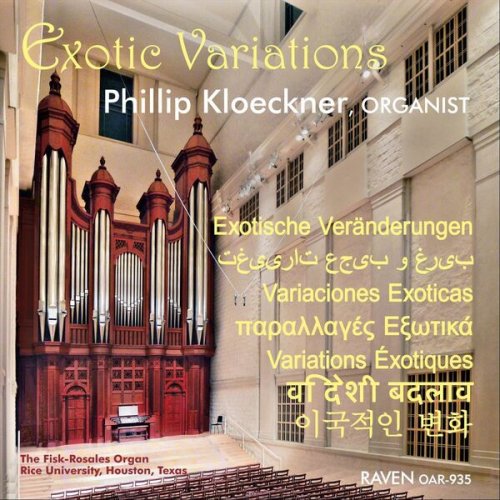
BAND/ARTIST: Phillip Kloeckner
- Title: Exotic Variations: The Fisk-Rosales Organ, Rice University
- Year Of Release: 2014
- Label: Raven
- Genre: Classical
- Quality: FLAC (tracks)
- Total Time: 1:07:13
- Total Size: 223 MB
- WebSite: Album Preview
Tracklist:
1. Phillip Kloeckner – Organ Symphony No. 2, Op. 20: I. Allegro (08:30)
2. Phillip Kloeckner – Organ Symphony No. 2, Op. 20: II. Choral (08:09)
3. Phillip Kloeckner – Organ Symphony No. 2, Op. 20: III. Scherzo (04:40)
4. Phillip Kloeckner – Organ Symphony No. 2, Op. 20: IV. Cantabile (08:15)
5. Phillip Kloeckner – Organ Symphony No. 2, Op. 20: V. Final (09:02)
6. Phillip Kloeckner – Variations on "Wie schön leuchtet der Morgenstern: Coral (01:24)
7. Phillip Kloeckner – Variations on "Wie schön leuchtet der Morgenstern: Coral in cantu, á 4 voci (01:26)
8. Phillip Kloeckner – Variations on "Wie schön leuchtet der Morgenstern: Bicinium (01:39)
9. Phillip Kloeckner – Variations on "Wie schön leuchtet der Morgenstern: Coral in tenore, á 3 voci (01:40)
10. Phillip Kloeckner – Variations on "Wie schön leuchtet der Morgenstern: Coral in basso, á 4 voci (01:46)
11. Phillip Kloeckner – Variations on "Wie schön leuchtet der Morgenstern: Coral in basso, á 3 voci (01:56)
12. Phillip Kloeckner – Variations on "Wie schön leuchtet der Morgenstern: Coral in cantu, coloratus, á 4 voci (01:38)
13. Phillip Kloeckner – Six variations sur un psaume huguenot, Op. 1: Organ-Choral en taille (00:56)
14. Phillip Kloeckner – Psalm 92 Verse 1 (00:52)
15. Phillip Kloeckner – Six variations sur un psaume huguenot, Op. 1: Variation 1 (00:53)
16. Phillip Kloeckner – Psalm 92 Verse 3 (00:50)
17. Phillip Kloeckner – Six variations sur un psaume huguenot, Op. 1: Variation 2 (01:31)
18. Phillip Kloeckner – Psalm 92 Verse 7 (00:51)
19. Phillip Kloeckner – Six variations sur un psaume huguenot, Op. 1: Variation 3 (00:24)
20. Phillip Kloeckner – Psalm 92 Verse 12 (00:49)
21. Phillip Kloeckner – Six variations sur un psaume huguenot, Op. 1: Variation 4 (02:00)
22. Phillip Kloeckner – Psalm 92 Verse 14 (00:48)
23. Phillip Kloeckner – Six variations sur un psaume huguenot, Op. 1: Variation 5 (01:13)
24. Phillip Kloeckner – Psalm 92 Verse 4 (00:49)
25. Phillip Kloeckner – Six variations sur un psaume huguenot, Op. 1: Variation 6 (04:59)
1. Phillip Kloeckner – Organ Symphony No. 2, Op. 20: I. Allegro (08:30)
2. Phillip Kloeckner – Organ Symphony No. 2, Op. 20: II. Choral (08:09)
3. Phillip Kloeckner – Organ Symphony No. 2, Op. 20: III. Scherzo (04:40)
4. Phillip Kloeckner – Organ Symphony No. 2, Op. 20: IV. Cantabile (08:15)
5. Phillip Kloeckner – Organ Symphony No. 2, Op. 20: V. Final (09:02)
6. Phillip Kloeckner – Variations on "Wie schön leuchtet der Morgenstern: Coral (01:24)
7. Phillip Kloeckner – Variations on "Wie schön leuchtet der Morgenstern: Coral in cantu, á 4 voci (01:26)
8. Phillip Kloeckner – Variations on "Wie schön leuchtet der Morgenstern: Bicinium (01:39)
9. Phillip Kloeckner – Variations on "Wie schön leuchtet der Morgenstern: Coral in tenore, á 3 voci (01:40)
10. Phillip Kloeckner – Variations on "Wie schön leuchtet der Morgenstern: Coral in basso, á 4 voci (01:46)
11. Phillip Kloeckner – Variations on "Wie schön leuchtet der Morgenstern: Coral in basso, á 3 voci (01:56)
12. Phillip Kloeckner – Variations on "Wie schön leuchtet der Morgenstern: Coral in cantu, coloratus, á 4 voci (01:38)
13. Phillip Kloeckner – Six variations sur un psaume huguenot, Op. 1: Organ-Choral en taille (00:56)
14. Phillip Kloeckner – Psalm 92 Verse 1 (00:52)
15. Phillip Kloeckner – Six variations sur un psaume huguenot, Op. 1: Variation 1 (00:53)
16. Phillip Kloeckner – Psalm 92 Verse 3 (00:50)
17. Phillip Kloeckner – Six variations sur un psaume huguenot, Op. 1: Variation 2 (01:31)
18. Phillip Kloeckner – Psalm 92 Verse 7 (00:51)
19. Phillip Kloeckner – Six variations sur un psaume huguenot, Op. 1: Variation 3 (00:24)
20. Phillip Kloeckner – Psalm 92 Verse 12 (00:49)
21. Phillip Kloeckner – Six variations sur un psaume huguenot, Op. 1: Variation 4 (02:00)
22. Phillip Kloeckner – Psalm 92 Verse 14 (00:48)
23. Phillip Kloeckner – Six variations sur un psaume huguenot, Op. 1: Variation 5 (01:13)
24. Phillip Kloeckner – Psalm 92 Verse 4 (00:49)
25. Phillip Kloeckner – Six variations sur un psaume huguenot, Op. 1: Variation 6 (04:59)
By the time Louis Vierne completed his second symphony for organ in 1903, the currents of twentieth-century musical expression and their strong challenges to traditional conceptions of harmony and melody were being felt everywhere. Nevertheless, the second symphony is in almost all respects a purely Romantic work that uses classical forms and late-romantic harmonies. Only in the final movement does Vierne carefully put aside the familiar tonic-dominant-tonic cadence in certain places and opt for less functional means of closing the larger formal sections of that movement. Rather than looking to a theoretical analysis for deeper understanding of this music, we should consider this symphony with respect to the instruments for which it was written and in the context of the Romantic movement, which had begun almost a century before.
Only in the last half of the nineteenth century did French organists have at their disposal the increasingly monumental organs conceived and built by Aristide Cavaillé-Coll and a few contemporaries. These new organs were capable of great subtleties of sound color and enormous dynamic contrasts. Only after the advent of these new instruments could the organist/composers conceive of writing music for such symphonic instruments that did truly emulate many of the effects of the orchestras of their day. (The Grand Organ of Edythe Bates Old Recital Hall was patterned after the largest and most celebrated of Cavaillè-Coll’s instruments.) César Franck was the first to begin writing for these organs in an entirely new, symphonic style. Charles Marie Widor developed Franck’s conception and wrote ten complete multi-movement organ symphonies. It was in Louis Vierne, Widor’s pupil and organist at Notre-Dame from 1900 to 1937, that the French organ symphony found its fullest and final realization.
Vierne’s second symphony is a cyclical work, meaning that the entire composition is built upon very few musical ideas. Each movement uses and develops some part of the two principal themes, which are introduced in the first few minutes of the first movement. Dotted rhythms and large intervals characterize the first theme. The second theme is much smoother than the first and exhibits even eighth notes moving in conjunct motion. Throughout the five movements of the symphony, the rhythm and shape of these themes are ingeniously altered so as to seem new and fresh, all the while heading for their ultimate confluence in the last movement.
Cyclical works were very popular among composers of the Romantic era because in the rhythmic and melodic alterations of the principal theme(s), they found the perfect poetic vehicle to express the many shades of pain, suffering, and disappointment that were inevitably part of living the life of a true artist. Indeed, it was ultimately in the final transformation and presentation of the thematic material in the final sections of the large cyclical works that many Romantic composers saw a redemption and affirmation of their lives and work. Vierne clearly identified with the image of the suffering artist. He was blind at birth and gained only limited sight after difficult surgery. He constantly struggled to make ends meet. Separation, death, and disappointment marked his personal and professional life.
In the five movements of this, his first cyclical work, Vierne plumbs the depths of his themes for their tragic, wistful, and wry implications, giving them heroic release and apotheosis in the final moments of the symphony.
The importance of Samuel Scheidt in the development of northern European keyboard music cannot be overstated. He received from his Dutch mentor, Jan Pieterszoon Sweelinck, a highly developed compositional technique which Scheidt continued to develop and refine. The technical demands Scheidt places on the player, as well as the variety of figuration, surpass those of his predecessors. It would not be until several generations later that Scheidt’s achievements in the keyboard variation genre would be brought to higher levels through the numerous capabilities of J. S. Bach. The well- known and beloved melody of Philipp Nicolai’s hymn for the Christian liturgical season of Epiphany, Wie Schön leuchtet, probably originated in the later Middle Ages and the repertoire of the noblemen-poet-musicians, the minnesingers. It is believed that Nicolai, himself a writer, musician, and theologian, adapted the melody to his hymn. Throughout the past four hundred years, the music and words (although altered and translated to varying degrees during that time) have remained strongly associated with the Bethlehem star and the coming of the three wise men.
Not only is André Isoir’s opus no. 1 his only composition for solo organ, the work was written for, and won first prize in, the 1974 composition competition sponsored by the Amis de l’Orgue, and it continues to be one of the most respected organ works originating in the second half of the twentieth century. The first edition of the Six Variations was published by Forberg Verlag in 1979 and was reissued in a second edition (Editions Delatour France) in 2009, with welcome adjustments to a few perplexing technical challenges, a recasting of the opening chorale en taille (melody in the tenor voice), and changes suggested for registrations in almost every variation. Having learned the work from the first edition and having coached with Mr. Isoir using a manuscript of the second edition in preparation for this recording, I have followed all of textual details of the second edition as the master presented it to me in August 2008, a full year before its publication. I had developed great fondness for several of the suggested registrations in the first edition, so I have retained the spirit of those with the confidence that Mr. Isoir offers specific registrations and tempi as guidelines for creative performers who will, nevertheless, exploit the very best resources of the instrument at hand in service of the music and its affects.
The composer writes about the style of this composition only in the preface to the second edition. There he calls for rhythmic firmness, accompanied by the natural flexibility of the syllabic accents inherent in the sung melody. While working together in person on the eve of making this recording, he continually emphasized such nuance and subtlety in every variation, and in some instances, he insisted on non-notated alterations of durations (both increases and decreases) for dramatic and additional improvisatory effects. Therefore, those who hope or expect to find precise concurrence between the commercially available score and what is heard on this recording will almost certainly be surprised.
In the preface to the first edition, Mr. Isoir suggests that in performances of this work, a cantor should sing a verse from Psalm 92 in advance of each variation. Such a collaboration enhances and develops the intensity of the work through periodic repetition of the psalm tone, culminating in the glorious final variation through its recollection, recapitulation, and brilliant synthesis of the textures and sounds of all of the preceding variations. - Phillip Kloeckner
Only in the last half of the nineteenth century did French organists have at their disposal the increasingly monumental organs conceived and built by Aristide Cavaillé-Coll and a few contemporaries. These new organs were capable of great subtleties of sound color and enormous dynamic contrasts. Only after the advent of these new instruments could the organist/composers conceive of writing music for such symphonic instruments that did truly emulate many of the effects of the orchestras of their day. (The Grand Organ of Edythe Bates Old Recital Hall was patterned after the largest and most celebrated of Cavaillè-Coll’s instruments.) César Franck was the first to begin writing for these organs in an entirely new, symphonic style. Charles Marie Widor developed Franck’s conception and wrote ten complete multi-movement organ symphonies. It was in Louis Vierne, Widor’s pupil and organist at Notre-Dame from 1900 to 1937, that the French organ symphony found its fullest and final realization.
Vierne’s second symphony is a cyclical work, meaning that the entire composition is built upon very few musical ideas. Each movement uses and develops some part of the two principal themes, which are introduced in the first few minutes of the first movement. Dotted rhythms and large intervals characterize the first theme. The second theme is much smoother than the first and exhibits even eighth notes moving in conjunct motion. Throughout the five movements of the symphony, the rhythm and shape of these themes are ingeniously altered so as to seem new and fresh, all the while heading for their ultimate confluence in the last movement.
Cyclical works were very popular among composers of the Romantic era because in the rhythmic and melodic alterations of the principal theme(s), they found the perfect poetic vehicle to express the many shades of pain, suffering, and disappointment that were inevitably part of living the life of a true artist. Indeed, it was ultimately in the final transformation and presentation of the thematic material in the final sections of the large cyclical works that many Romantic composers saw a redemption and affirmation of their lives and work. Vierne clearly identified with the image of the suffering artist. He was blind at birth and gained only limited sight after difficult surgery. He constantly struggled to make ends meet. Separation, death, and disappointment marked his personal and professional life.
In the five movements of this, his first cyclical work, Vierne plumbs the depths of his themes for their tragic, wistful, and wry implications, giving them heroic release and apotheosis in the final moments of the symphony.
The importance of Samuel Scheidt in the development of northern European keyboard music cannot be overstated. He received from his Dutch mentor, Jan Pieterszoon Sweelinck, a highly developed compositional technique which Scheidt continued to develop and refine. The technical demands Scheidt places on the player, as well as the variety of figuration, surpass those of his predecessors. It would not be until several generations later that Scheidt’s achievements in the keyboard variation genre would be brought to higher levels through the numerous capabilities of J. S. Bach. The well- known and beloved melody of Philipp Nicolai’s hymn for the Christian liturgical season of Epiphany, Wie Schön leuchtet, probably originated in the later Middle Ages and the repertoire of the noblemen-poet-musicians, the minnesingers. It is believed that Nicolai, himself a writer, musician, and theologian, adapted the melody to his hymn. Throughout the past four hundred years, the music and words (although altered and translated to varying degrees during that time) have remained strongly associated with the Bethlehem star and the coming of the three wise men.
Not only is André Isoir’s opus no. 1 his only composition for solo organ, the work was written for, and won first prize in, the 1974 composition competition sponsored by the Amis de l’Orgue, and it continues to be one of the most respected organ works originating in the second half of the twentieth century. The first edition of the Six Variations was published by Forberg Verlag in 1979 and was reissued in a second edition (Editions Delatour France) in 2009, with welcome adjustments to a few perplexing technical challenges, a recasting of the opening chorale en taille (melody in the tenor voice), and changes suggested for registrations in almost every variation. Having learned the work from the first edition and having coached with Mr. Isoir using a manuscript of the second edition in preparation for this recording, I have followed all of textual details of the second edition as the master presented it to me in August 2008, a full year before its publication. I had developed great fondness for several of the suggested registrations in the first edition, so I have retained the spirit of those with the confidence that Mr. Isoir offers specific registrations and tempi as guidelines for creative performers who will, nevertheless, exploit the very best resources of the instrument at hand in service of the music and its affects.
The composer writes about the style of this composition only in the preface to the second edition. There he calls for rhythmic firmness, accompanied by the natural flexibility of the syllabic accents inherent in the sung melody. While working together in person on the eve of making this recording, he continually emphasized such nuance and subtlety in every variation, and in some instances, he insisted on non-notated alterations of durations (both increases and decreases) for dramatic and additional improvisatory effects. Therefore, those who hope or expect to find precise concurrence between the commercially available score and what is heard on this recording will almost certainly be surprised.
In the preface to the first edition, Mr. Isoir suggests that in performances of this work, a cantor should sing a verse from Psalm 92 in advance of each variation. Such a collaboration enhances and develops the intensity of the work through periodic repetition of the psalm tone, culminating in the glorious final variation through its recollection, recapitulation, and brilliant synthesis of the textures and sounds of all of the preceding variations. - Phillip Kloeckner
As a ISRA.CLOUD's PREMIUM member you will have the following benefits:
- Unlimited high speed downloads
- Download directly without waiting time
- Unlimited parallel downloads
- Support for download accelerators
- No advertising
- Resume broken downloads